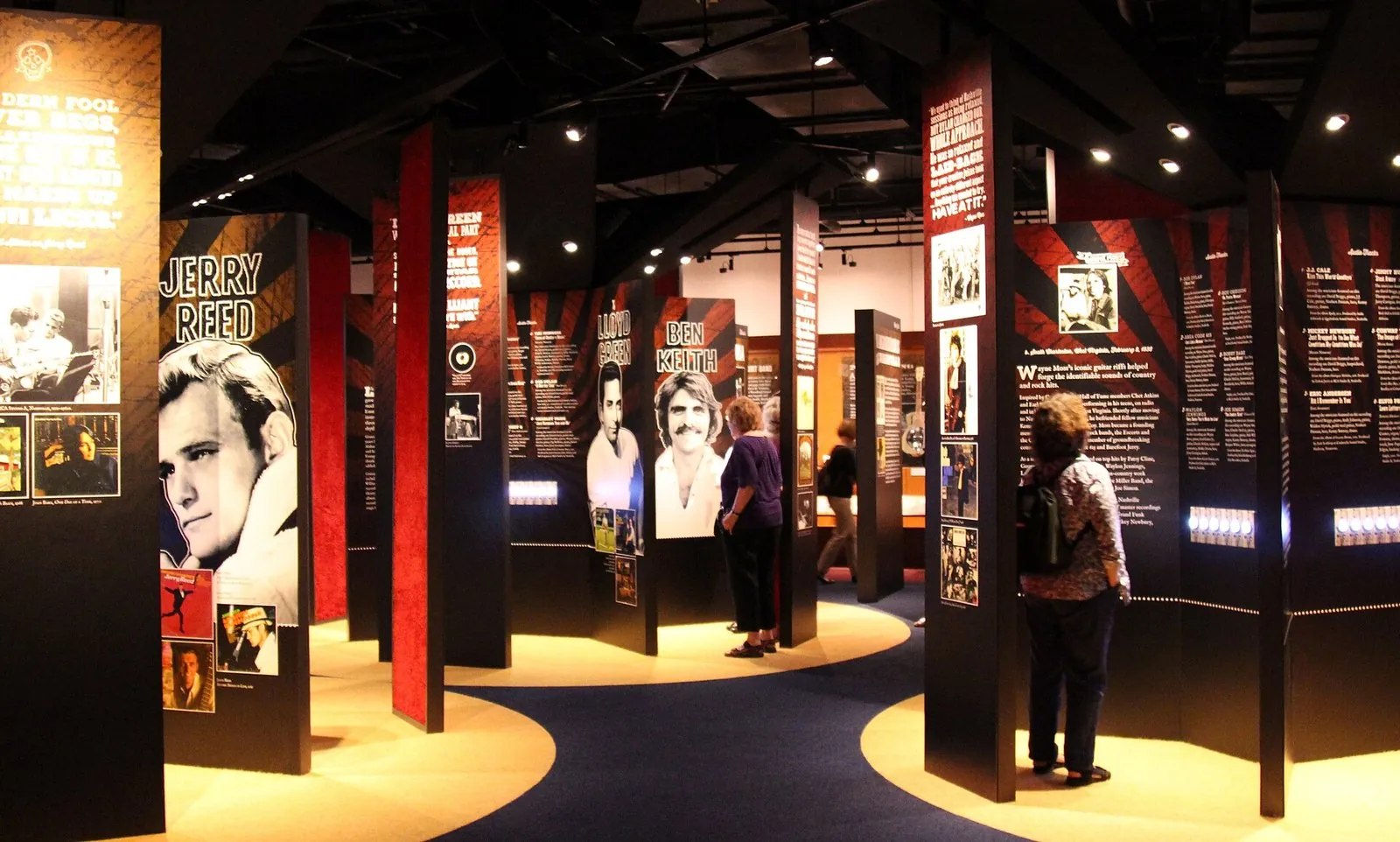
The Country Music Hall of Fame is the music museum to put first on a Nashville trip: a downtown museum at 222 Rep. John Lewis Way South, open 9am to 5pm daily, with adult tickets at $31.95 and youth tickets (ages 6 to 12) at $21.95. Plan on two and a half to three hours, and get there at opening.
This guide covers the Hall of Fame in depth, then sets it beside the city’s other music museums and working landmarks: the Johnny Cash Museum, the National Museum of African American Music, the Musicians Hall of Fame, the Ryman Auditorium, RCA Studio B and Hatch Show Print. The caveat that matters is money. Every one of them sells its own ticket, three museums run about $98 a person before tax, and nobody needs all seven in one trip. Pick the two or three that match what you actually listen to.
Last updated October 9, 2026. Prices, rules and details checked October 2026.
The Short Version
If you read only one table, make it this one. It matches the museum to the traveler rather than the other way around.
| If you… | Go to | Why |
|---|---|---|
| Have time for one music museum | Country Music Hall of Fame | The deepest collection in the genre, the Hall of Fame rotunda and a building that fills a morning |
| Care more about records than costumes | RCA Studio B tour | A $23 add-on to the Hall of Fame; the room where Elvis Presley and Dolly Parton recorded |
| Want the bigger American music story | National Museum of African American Music | Spirituals to hip-hop under one roof, with the most hands-on galleries in town |
| Grew up on Johnny Cash | Johnny Cash Museum | One artist, done thoroughly, and open until 7pm |
| Play an instrument | Musicians Hall of Fame | The session players behind the hits, with the gear they used |
| Want to stand on a famous stage | Ryman Auditorium tour | $25 plus tax self-guided, with a souvenir photo on the stage |
| Are watching every dollar | NMAAM on the first Wednesday, Hatch Show Print’s gallery | Free entry if you time it right |
How do Nashville’s music museums compare on price, hours and time?
Here is the whole field side by side. Prices are the posted adult rates in October 2026. The time column is our planning estimate for a curious adult who reads some panels and skims others; the museums don’t publish those figures, and a superfan can double any of them.
| Museum or tour | Adult ticket | Open | Time needed | Where |
|---|---|---|---|---|
| Country Music Hall of Fame | $31.95 | Daily 9am to 5pm | 2.5 to 3 hours | 222 Rep. John Lewis Way S |
| RCA Studio B tour | $23 add-on to museum admission | Departs the museum 10am to 3pm | About 1 hour, shuttle included | Music Row (by museum shuttle only) |
| Hatch Show Print | Gallery free; tours $20 | Tours at 11am, noon, 2pm, 3pm | 15 to 20 minutes for the gallery | Inside the Hall of Fame building |
| Johnny Cash Museum | $32.95 plus tax | Daily 9am to 7pm | 60 to 90 minutes | 119 3rd Ave S |
| National Museum of African American Music | $33.33 | Tue to Sat 10am to 5pm; Sun and Mon noon to 5pm; last entry 4pm | 2 to 2.5 hours | 598 Broadway |
| Musicians Hall of Fame | See its price page | Mon to Sat 10am to 5pm; closed Sun | 1.5 to 2 hours | 401 Gay St |
| Ryman Auditorium tour | $25 plus tax self-guided; $42.52 plus tax guided | About 9am to 4pm, around shows | 45 to 90 minutes | 116 Rep. John Lewis Way N |
| Opry Daytime Tour | $46.65 with taxes and fees | Varies by day | About 50 minutes | 600 Opry Mills Dr |
Three things jump out. First, the big three museums (the Hall of Fame, the Johnny Cash Museum and NMAAM) sit within $1.38 of each other, so price shouldn’t decide between them; content and time should. Second, the Johnny Cash Museum’s 7pm close makes it the only one you can still visit after a full day elsewhere. Third, NMAAM opens at noon on Sundays and Mondays and takes its last visitors at 4pm, which catches out anyone who pencils it in as a late-afternoon stop.
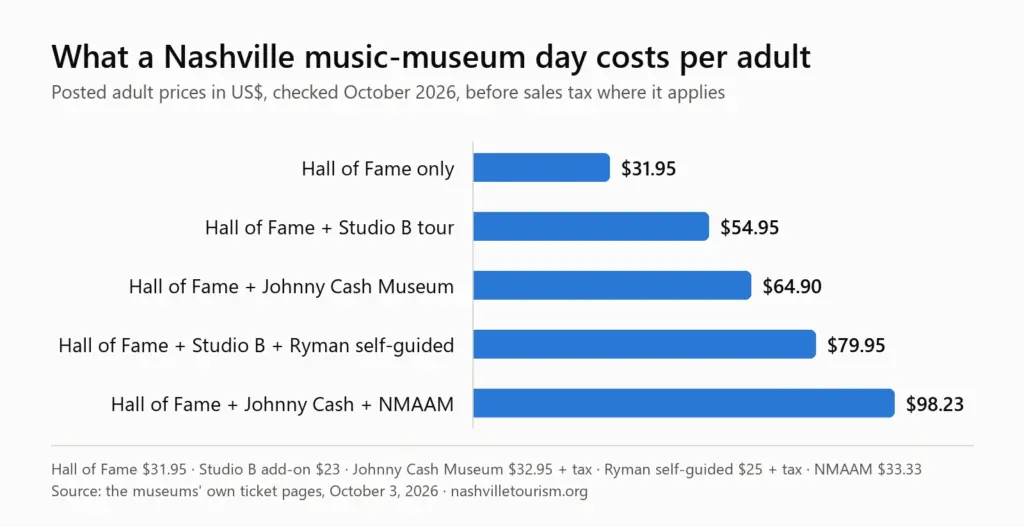
Combinations add up faster than people expect. The Hall of Fame plus the Studio B tour is $54.95 a person. Swap Studio B for the Johnny Cash Museum and it’s $64.90 before tax. The Hall of Fame, Johnny Cash and NMAAM together come to $98.23, so a couple doing all three spends roughly $200 before tax, parking and lunch. That’s the honest argument for choosing, and for the free options later in this guide.
Is the Country Music Hall of Fame worth it?
For most first-time visitors, yes, including plenty who don’t think of themselves as country fans. The museum isn’t a shrine to whatever is on the radio this year. It’s a history of how rural string-band music became a national industry, told through instruments, stage clothes, recording gear, handwritten lyrics and film, and it keeps finding the places where country crossed paths with gospel, blues, rock and roll and pop. If you like museums at all, there’s a full morning here.
The value math backs that up. At $31.95 for a visit that fills about three hours, you’re paying a little over $10 an hour. The Johnny Cash Museum costs a dollar more for a visit most people finish in 60 to 90 minutes. Neither is cheap, but the Hall of Fame gives you more museum per dollar than anything else on this list apart from the free options.
Who should skip it? Travelers with less than two hours, for a start: rushing the Hall of Fame wastes the ticket, and the Johnny Cash Museum or a Ryman self-guided tour fits a short window better. Anyone who actively dislikes country should go to the National Museum of African American Music instead, which covers more musical ground and gives your hands more to do. And if what you love is the songwriting rather than the artifacts, an evening at a listening room, where writers play their own songs in the round, will teach you more about Nashville than any glass case.
One more honest note. The Hall of Fame is busiest from about 11am to 2pm, when tour groups, conventioneers and late risers overlap. A 9am entry is the difference between reading the panels and reading the back of someone’s head.
What’s inside the Country Music Hall of Fame
The current building opened downtown in 2001, replacing the original 1967 museum at the head of Music Row, and a 2014 expansion roughly doubled its size. It holds the permanent exhibition, the rotunda, rotating special exhibitions, two theaters, an education center, the Hatch Show Print shop and the museum’s library and archive. Most visitors spend nearly all their time in the first three, and that’s the right call.
Sing Me Back Home: the core exhibition
The permanent exhibition, Sing Me Back Home: A Journey Through Country Music, runs roughly in chronological order. It starts with the ballads and fiddle tunes that came over with British and Irish settlers and the banjo’s African roots, moves through the first commercial recordings of the 1920s and the radio barn dances, then honky-tonk, the Nashville Sound, the Bakersfield answer to it, outlaw country and the arena era. The galleries mix big objects (instruments, cars, stage clothes) with listening stations and short films, and the labels are written for curious adults rather than for experts.
Pace yourself. The early rooms are dense with material that rewards slow reading, and it’s common to spend an hour there and then race through the decades you actually grew up with. If you know which era you care about, move briskly through the others and give your favorite the time.
The rhinestone stage suits from the Nudie and Manuel workshops are a reliable crowd favorite, and the instrument cases tell their own story about how the sound changed, from flat-top acoustics to the electric guitars that gave honky-tonk and Bakersfield their twang. Displays rotate, so treat any single object as a maybe rather than a promise.
The Hall of Fame Rotunda
The rotunda is the museum’s quiet center: a tall, round room lined with the bronze plaques of every member, under a frieze carrying the words of “Will the Circle Be Unbroken.” The honor began in 1961, when the Country Music Association inducted Jimmie Rodgers, Fred Rose and Hank Williams. Since then a handful of new members have been added most years, nominated by a panel of industry leaders and chosen by a few hundred electors from the CMA.
Read the plaques with that process in mind. Membership includes songwriters, session musicians, broadcasters and executives as well as stars, which is why you’ll find names you don’t recognize next to the ones you do. That’s the point: the Hall of Fame honors the people who built the industry, not only the ones on the album covers. It’s also the room where people photograph each other and, without being asked, lower their voices.
Elvis’s Cadillac and the other star objects
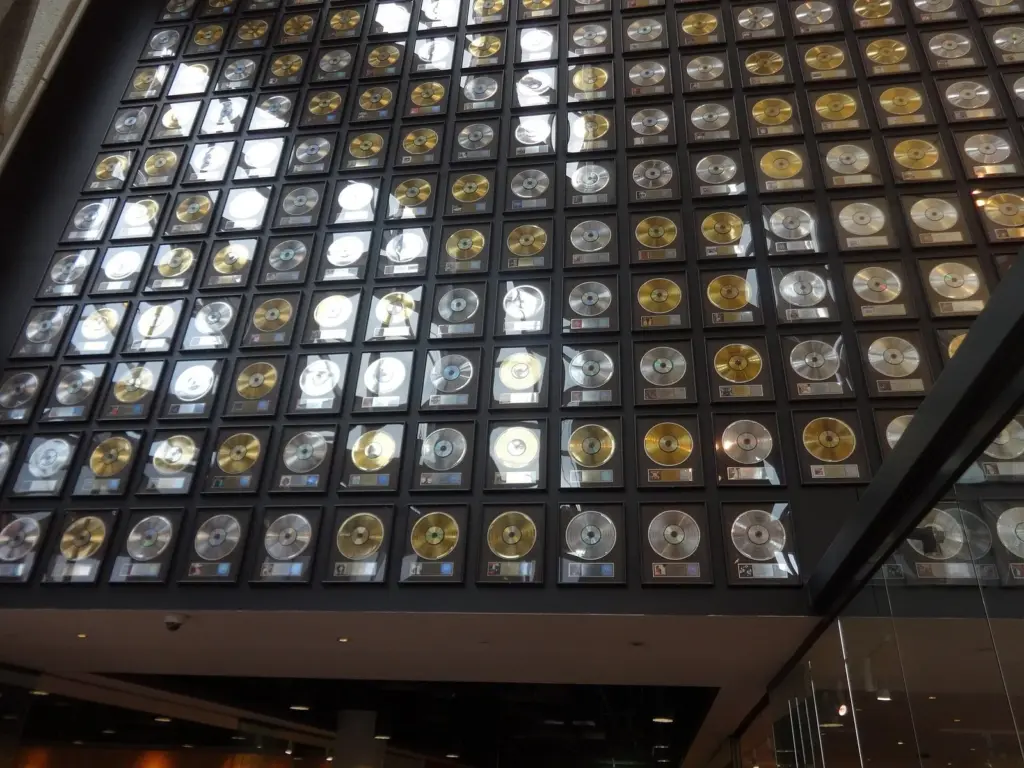
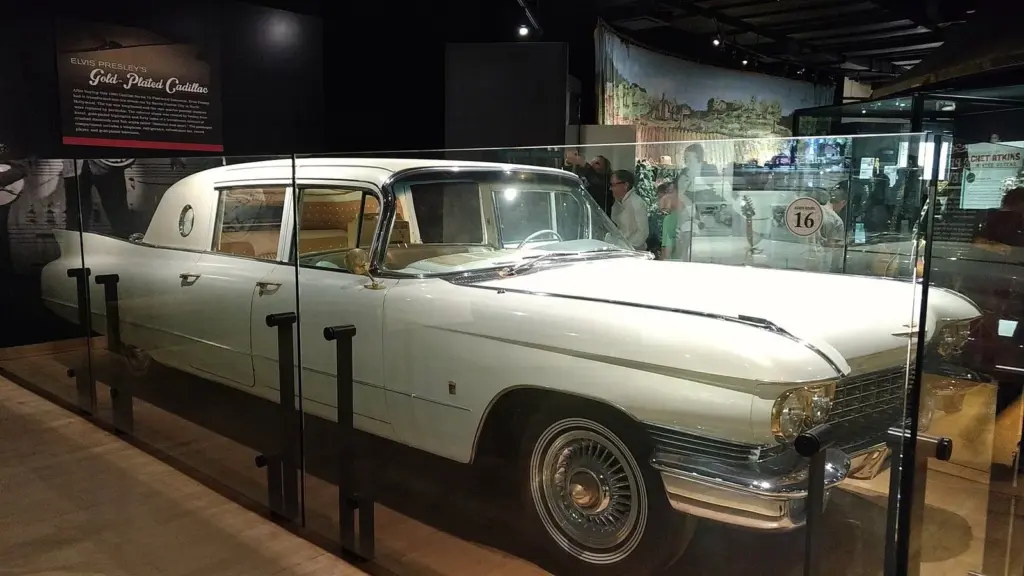
Two things stop almost everyone. The first is the wall of gold and platinum records that climbs through the core exhibition. The second is Elvis Presley’s 1960 Cadillac limousine with its gold-plated trim, one of the collection’s signature pieces and a reminder that Elvis recorded more than 200 songs in Nashville, a story you can follow to RCA Studio B the same day.
Around those headliners are hundreds of smaller things that tell the story better: a songwriter’s notebook with the crossings-out still visible, a battered guitar that played on a run of hits, a radio microphone from the barn-dance era. Give the small cases a minute each and the museum gets much better.
Special exhibitions
Alongside the permanent galleries, the museum runs special exhibitions on single artists, eras or scenes, usually for a year or more at a time. The exhibitions page on its website lists what’s open for your dates. Look before you go: a show on an artist you love can justify an extra hour, and a big new opening can mean bigger crowds that week.
For families: the Taylor Swift Education Center
Families get more than a quiet walk past glass. The Taylor Swift Education Center, named for the singer, whose donation helped build it, hosts hands-on programs such as songwriting workshops; schedules vary, so check the museum’s calendar. Two money notes for parents: youth tickets (6 to 12) are $21.95, and kids 18 and under who live in Davidson County or a bordering county get in free under the museum’s Local Kids Visit Free program. Our guide to things to do in Nashville with kids has the rest of the family list.
Country Music Hall of Fame tickets, hours and the best time to go
Tickets and add-ons
General admission is $31.95 for adults (13 and up) and $21.95 for youth ages 6 to 12; younger children get in free. The museum sells tickets online through its Select Your Experience page, where you can add the RCA Studio B tour for $23 or build a package that includes a Hatch Show Print tour. Buy ahead for busy dates (summer Saturdays, holiday weeks, big event weekends): it saves a line at the desk and locks in a Studio B departure, since each tour travels by shuttle with limited seats.
Beyond the local-kids program, the museum lists group pricing and a pay-what-you-want offer for locals, both aimed at residents and organized groups. Visitors from out of town should expect to pay the posted rate, which is why the cheaper options later in this guide are worth a look if the budget is tight.
Hours and the best time to go
The museum is open seven days a week from 9am to 5pm Central. The crush runs from about 11am to 2pm, when tour groups, conventioneers from the Music City Center and everyone who slept in arrive together. Arrive at 9am and you’ll beat most of that crowd to the early galleries; arrive at 3pm and you’ll be rushing the later decades before the 5pm close.
Weekdays beat weekends. January, February and the weeks after Labor Day are calmer than June and July, and CMA Fest in early June fills the whole of downtown with country fans. In July, when highs average 91°F, an air-conditioned museum morning is also a sensible way to save your energy for the evening. For the month-by-month picture, see our guide to the best time to visit Nashville.
Parking and getting there
The Hall of Fame stands at 222 Rep. John Lewis Way South, the street older guides call Fifth Avenue South, a block and a half from Broadway and across the street from the Music City Center. From most downtown and SoBro hotels it’s a walk of 5 to 15 minutes. Drivers have plenty of garages: the Music City Center garage posted $15 for up to five hours in 2026, and Metro-owned downtown garages cap at $3 to $20 for the day, with event pricing on game and concert nights. Street meters run $2 to $6 an hour depending on the zone, with time limits that don’t suit a three-hour visit.
If you’re staying out by Opryland or in the suburbs, a rideshare into downtown and a walking day between the museums is usually less hassle than moving a car between garages. Our guide to getting around Nashville covers buses, rideshares and parking in more detail.
RCA Studio B: the tour you can only book at the Hall of Fame
RCA Studio B is the best add-on in Nashville music tourism, and the only way inside is the guided tour sold by the Country Music Hall of Fame. Tours leave the museum daily between 10am and 3pm, a shuttle covers the mile or so to Music Row and back, and the add-on costs $23 on top of museum admission. Allow about an hour for the round trip.
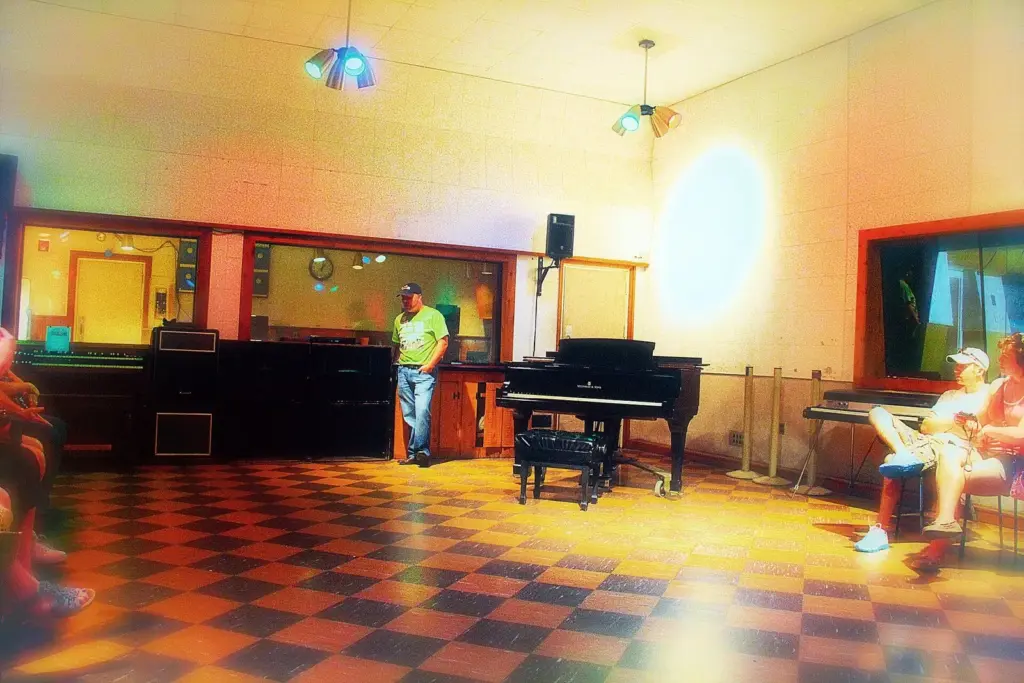
RCA opened the studio in 1957, and over the next two decades it became one of the busiest rooms in American music. Guitarist and producer Chet Atkins helped shape the polished Nashville Sound here, with string sections and smooth backing vocals pulling country toward the pop charts. Elvis Presley recorded more than 200 songs in the building, “Are You Lonesome Tonight?” among them. The Everly Brothers and Roy Orbison cut hits here, and Dolly Parton recorded both “Jolene” and “I Will Always Love You” here on the same day in 1973.
The tour is short on walking and long on atmosphere. You sit in the main room, hear the stories, often with the recordings played back in the space where they were made, and look into the control room. The colored lights strung overhead are part of the lore; guides tie them to an Elvis Christmas session. If you care about records more than costumes, this is the hour of your trip you’ll still be describing at dinner.
Two practical notes. Book the departure when you buy museum tickets, since seats on each shuttle are limited. And see the museum first if you can: the Nashville Sound galleries make the studio far more meaningful. Studio B sits on Music Row, the strip of labels, publishers and studios southwest of downtown that our guide to Nashville neighborhoods covers. If you’d rather see the area with a narrator, the trolley and van tours in our roundup of Nashville tours pass along the street, though none of them take you inside Studio B.
Hatch Show Print: letterpress posters in the museum building
Hatch Show Print has been printing show posters by hand since 1879, which makes it one of the oldest working letterpress shops in the country. The bold, woodblock-style posters you see for Ryman concerts, Opry anniversaries and touring bands come out of here, carved and set by hand and pulled on presses older than most of the performers on them. Since 2013 the shop has lived inside the Country Music Hall of Fame building, after decades in downtown storefronts that included its old shop on Broadway.
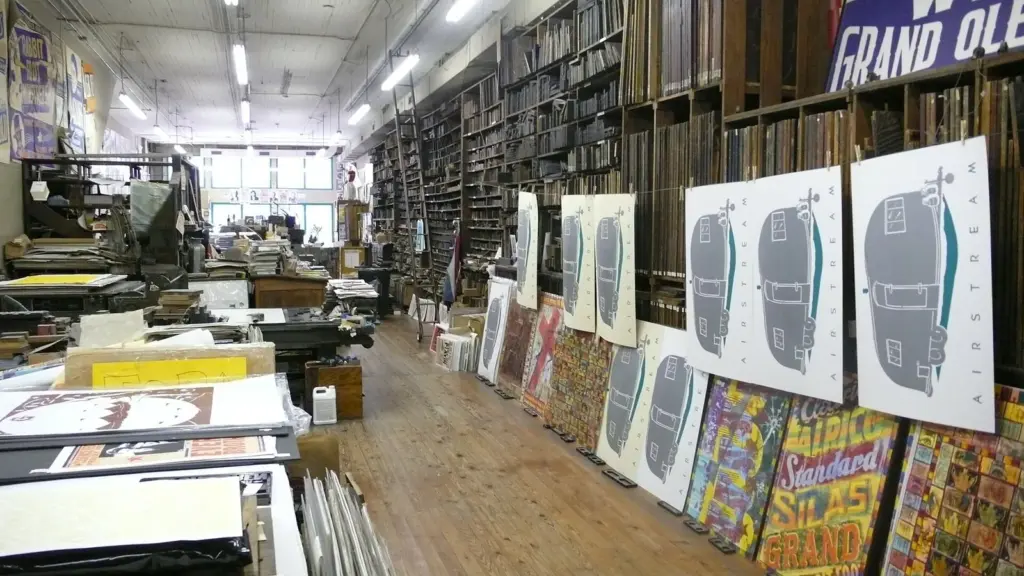
Watching the shop work and walking through its gallery costs nothing. The guided tours, which go into the history and the printing process, are listed at $20 for adults and $15 for youth on Hatch’s own site, with departures at 11am, noon, 2pm and 3pm; museum packages bundle the tour at a different price. Allow 15 to 20 minutes for the free look and longer for a tour.
Is the tour worth paying for? If you have any interest in printing, type or graphic design, yes: it’s one of the few places in Nashville where you watch a craft being done rather than displayed. If not, the free gallery and a poster from the shop make a better souvenir than another T-shirt from Broadway.
Nashville’s other music museums, ranked
Once the Hall of Fame is on your list, here is how the rest stack up. The ranking weighs what each does that nothing else in town does, how much time it rewards and what it costs. It isn’t a verdict on the music.
1. National Museum of African American Music
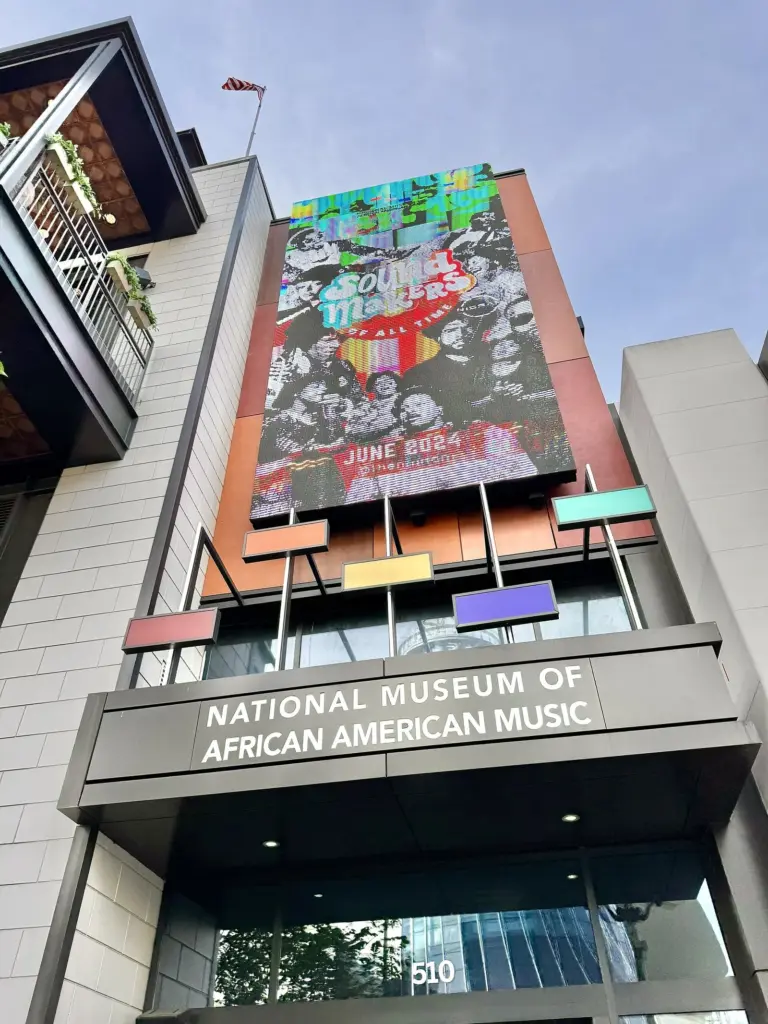
NMAAM is arguably the most important music museum to open in Nashville in a generation, and the right counterweight to a country-heavy trip. Opened in January 2021 at Fifth + Broadway, it traces more than 50 genres created, shaped or inspired by African Americans, from spirituals and the blues through jazz, gospel, R&B and hip-hop, and it does so with more hands-on interaction than any other museum in town. A wristband saves the interactive moments, from singing with a virtual gospel choir to learning dance moves and building a beat, so you can revisit them later.
It also tells a Nashville story the other museums only touch. The Fisk Jubilee Singers, the student choir from Fisk University that began touring in 1871 to raise money for the school, are central to the city’s musical identity; the local legend is that Queen Victoria heard them sing and said they must come from a city of music. Jefferson Street, north of downtown, was a center of Black nightlife from the 1940s into the 1960s, with clubs where Jimi Hendrix played before anyone knew his name.
Adults pay $33.33. Seniors 65 and over, military and first responders pay $31.33; students, educators and youth 5 to 17 pay $29.33 (discounts in person, with ID); children 4 and under are free. The galleries are free on the first Wednesday of every month under Nissan Free Wednesdays, although the interactive wristbands cost $5 on those days and free entry doesn’t include Jubilation!. Hours are 10am to 5pm Tuesday to Saturday and noon to 5pm on Sundays and Mondays, with last entry at 4pm; it closes on Thanksgiving and Christmas.
Give it two to two and a half hours. The building’s Metropolis garage charges a $25 flat rate with validation in the museum lobby, and the L&C Garage at 144 Fifth Avenue North posts $10 for the first three hours, but if you’re staying downtown, just walk: the museum is a block from the Ryman.
2. Ryman Auditorium daytime tour
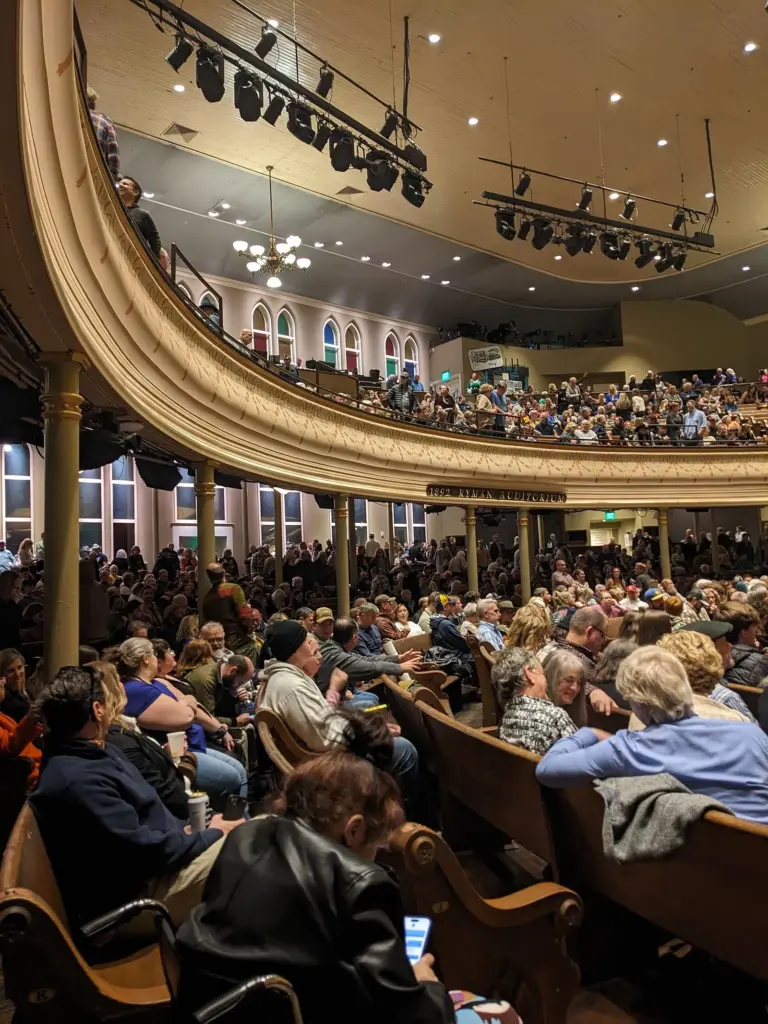
The Ryman isn’t a museum, which is exactly why it ranks this high. Built in 1892 as the Union Gospel Tabernacle, it housed the Grand Ole Opry from 1943 to 1974, hosted the television tapings of The Johnny Cash Show from 1969 to 1971 and still books concerts most nights of the week. Bluegrass historians point to its stage as the place where Earl Scruggs’s three-finger banjo joined Bill Monroe’s band in 1945. Walking into the room is the point.
Daytime tours run from about 9am to 4pm, fitted around the show schedule. The self-guided tour is $25 plus tax, and children 12 and under go free with a paying adult. The Guided Backstage Tour, $42.52 plus tax with fees included, pairs 45 minutes with a guide behind the scenes with 45 minutes on your own; a VIP version at $62.02 plus tax adds soft drinks and a swag bag with a Hatch Show Print poster. Every tour includes a professional souvenir photo on the stage.
The self-guided tour is enough for most people: the short film at the start, the hallway exhibits and time in the pews and on the stage take 45 to 75 minutes. Pay for the backstage tour if you’re a serious fan of the artists who used those dressing rooms. Better still, buy a concert ticket, because a night at the Ryman beats any tour of it; our guide to live music in Nashville explains how Ryman tickets, seats and the Opry work.
3. Johnny Cash Museum
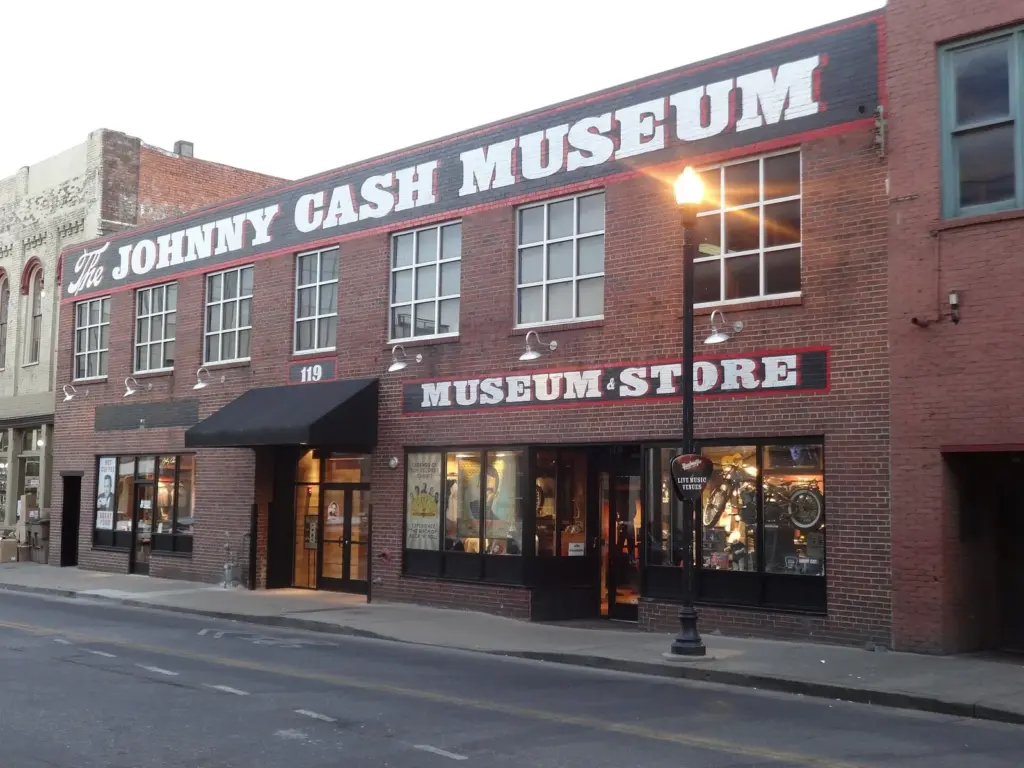
The Johnny Cash Museum does one artist thoroughly, and if that artist is yours, it’s the best 90 minutes you’ll spend downtown. Opened in 2013 by collector Bill Miller at 119 Third Avenue South, it follows Cash from the Arkansas cotton farm through Sun Records, Folsom Prison, the television years and the late American Recordings albums, with costumes, instruments, handwritten lyrics, awards and a stone wall rebuilt from his lakeside home in Hendersonville.
General admission is $32.95 plus tax. Youth 6 to 15 pay $28.95 plus tax with an adult admission, children 5 and under go free, and AAA members, military, seniors and students get $1 off. It’s open 9am to 7pm every day except Thanksgiving and Christmas, which makes it the natural late-afternoon stop after the Hall of Fame closes at 5pm.
The honest verdict: for Cash fans it’s essential; for casual visitors it’s good but pricey for the time it takes; and the youth price is steep for families with kids who don’t know the songs. Older guides pair it with the Patsy Cline Museum upstairs, which closed in May 2025, so don’t plan around that combination.
4. Musicians Hall of Fame and Museum
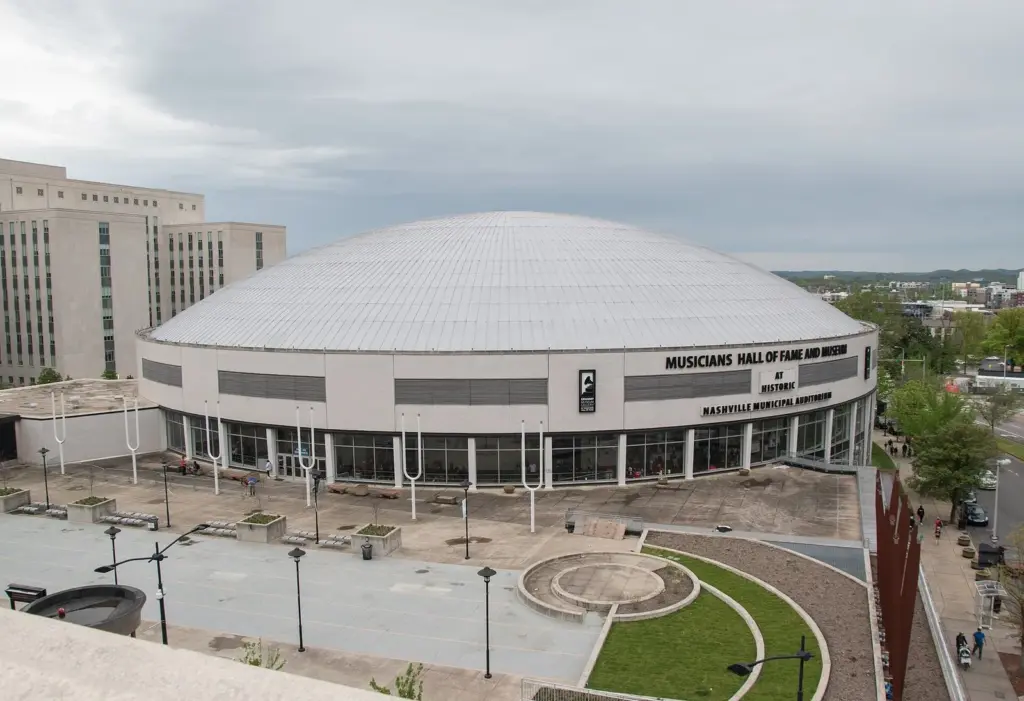
Most music museums celebrate the names on the record sleeve. The Musicians Hall of Fame celebrates the people who played on the record: session players such as Nashville’s A-Team, the Wrecking Crew from Los Angeles, Motown’s Funk Brothers and the Muscle Shoals Rhythm Section, whose instruments sit beside the hits they played on. For anyone who plays, or anyone who has wondered who actually played that guitar part, it’s the most satisfying museum in town.
It’s inside the domed Municipal Auditorium at 401 Gay Street, at the north end of downtown and roughly a 10 to 15 minute walk from Broadway. It opens Monday to Saturday from 10am to 5pm and closes on Sundays, Thanksgiving, Christmas Eve, Christmas Day and New Year’s Day; check current admission on its Information & Prices page. A hands-on gallery lets you try instruments and recording gear, which makes it a good rainy-day pick for teenagers who play.
Give it 90 minutes to two hours. It ranks fourth only because it’s the most specialized of the four museums: brilliant for musicians and record collectors, slower going for everyone else.
5. Grand Ole Opry backstage tours
The Opry is a radio show, not a museum, and it lives at the Grand Ole Opry House at 600 Opry Mills Drive, about 10 miles northeast of downtown, not at the Ryman. It has gone back to the Ryman for winter runs, but the January 2026 stint lasted one week and no 2027 run had been announced when we checked, so never assume it’s downtown; check the Opry’s calendar for your dates. The backstage tours are the museum-style way in. The Opry Daytime Tour costs $46.65 including taxes and fees and spends about 50 minutes in the backstage halls, the dressing rooms, the stage and the WSM radio studio. A VIP Tour, new in 2026, runs 90 minutes for $88.34, the Women of Country Tour is $59.81, and the $45 Post-Show Tour requires a ticket to that night’s show.
It ranks last here only because of geography: it’s a separate trip from the downtown museums. Pair it with an Opry show that evening and it makes complete sense. As a standalone daytime outing, the Ryman tour gives you more history for less money.
Free and cheap ways into Nashville’s music history
A tight budget doesn’t mean skipping the history. It means timing your visits and knowing which doors are open for free.
- NMAAM on the first Wednesday: the galleries are free on the first Wednesday of every month, and the interactive wristbands are $5.
- Hatch Show Print’s gallery: free to walk in, browse the posters and watch the presses.
- Local kids at the Hall of Fame: free admission for anyone 18 and under who lives in Davidson County or a bordering county.
- The Ryman with children: kids 12 and under go free on the self-guided tour with a paying adult.
- Music City Walk of Fame Park: star plaques honoring music figures tied to Nashville, set in a small park steps from the Hall of Fame; free and outdoors.
- Tennessee State Museum: free, beside the Bicentennial Capitol Mall, open Tuesday to Saturday 10am to 5pm and Sunday 1pm to 5pm. It’s a state history museum rather than a music museum, but it fills in the story around the songs.
- Jefferson Street Sound Museum: a small nonprofit museum, studio and rehearsal hall preserving Jefferson Street’s music history; check its hours before you go.
Our full list of free things to do in Nashville adds the free live music on Broadway, the parks and the rest of the no-cost options.
A walkable music-museum day in downtown Nashville
Every main stop in this guide except the Opry House is within about a 15-minute walk of the others, so a car is a liability on this day, not an asset. This route front-loads the Hall of Fame to beat the midday crowd and uses the Johnny Cash Museum’s late hours to stretch the afternoon.
| Time | Stop | Notes |
|---|---|---|
| 9:00am | Country Music Hall of Fame | Start with Sing Me Back Home while it’s quiet; save the rotunda and the gift shop for the end |
| 11:30am | RCA Studio B tour | Leaves from the museum; book it with your ticket, or swap in a Hatch Show Print tour |
| 12:45pm | Lunch | Head toward Broadway or SoBro, and expect lines at the obvious spots after 1pm |
| 1:45pm | Ryman Auditorium self-guided tour | Half a block off Broadway; tours run until about 4pm, show schedule permitting |
| 3:15pm | Johnny Cash Museum | About a 7-minute walk from the Ryman; open until 7pm, so there’s no rush |
| Evening | A Ryman concert or Lower Broadway | Buy concert tickets ahead; the honky-tonks need no ticket at all |
The evening slot is where Nashville’s music history stops being history. The bars on Lower Broadway run live bands from late morning to late night with no cover at most of them, and our guide to Nashville’s honky-tonks sorts the good stages from the loud ones.
For a second day, swap in NMAAM (from 10am Tuesday to Saturday, last entry at 4pm) and the Musicians Hall of Fame (closed Sundays), then finish at the Opry House for a backstage tour and a show. Our Nashville itinerary shows how a museum day fits around the rest of a trip, and our guide to where to eat in Nashville covers lunch near the museums, from hot chicken to a meat-and-three, the Southern lunch-counter format of one meat and three vegetable sides.
Which music museum fits your trip?
First-time visitors: the Hall of Fame in the morning and the Ryman in the afternoon. That pairing covers the genre’s history and its most famous room, and both are a short walk from Broadway. To see how the music museums compare with the Parthenon, the zoo and the city’s other sights, read our guide to Nashville attractions.
Families: NMAAM’s interactive galleries hold children’s attention best, and the Ryman’s free self-guided entry for kids 12 and under helps the budget. The Hall of Fame works for older kids with an interest in music, especially when an education-center program is on. The Johnny Cash Museum’s $28.95 youth ticket is the hardest to justify for children who don’t know the songs.
Musicians and record collectors: the Musicians Hall of Fame and the Studio B tour, in that order of obsession. Add Hatch Show Print if you care how gig posters get made.
Groups and weekend trips: the Johnny Cash Museum’s 7pm close suits a late afternoon before dinner, and a Ryman self-guided tour fits between brunch and a night out. Our Nashville bachelorette party guide shows where a daytime stop fits around the rest of a group weekend.
Hot or wet days: every stop here except the Walk of Fame Park is indoors and air-conditioned. July highs average 91°F, so a museum morning followed by a pool afternoon is a sensible summer rhythm.
No car: everything except the Opry House is walkable from downtown hotels. The Opry is roughly 15 to 25 minutes away by car, longer on show nights, so price a rideshare both ways before you commit. For the rest of the city’s sights, see our list of things to do in Nashville.
What older guides to Nashville’s music museums get wrong
- The Patsy Cline Museum is closed. It shut in May 2025, so listicles that still pair it with the Johnny Cash Museum are out of date.
- NMAAM’s prices have changed. Adults pay $33.33 in 2026, and the galleries are free on the first Wednesday of each month.
- The Opry isn’t downtown. It plays the Opry House near Opry Mills nearly all year, and the winter Ryman run shrank to one week in January 2026.
- Hatch Show Print left Broadway. It has been inside the Hall of Fame building since 2013; older photos show the former storefront.
- The street has a new name. The Hall of Fame and the Ryman now carry Rep. John Lewis Way addresses, though older guides and some signs still say Fifth Avenue.
- The Musicians Hall of Fame moved. It has been in the Municipal Auditorium on Gay Street since 2013, after its first home made way for the Music City Center.
Country Music Hall of Fame FAQ
How long do you need at the Country Music Hall of Fame?
Plan on two and a half to three hours for the museum itself, and about an hour more if you add the RCA Studio B tour, which leaves from the museum by shuttle. Arrive at the 9am opening if you can: the galleries are busiest from about 11am to 2pm, and the museum closes at 5pm every day.
How much are Country Music Hall of Fame tickets?
Adult admission (13 and up) was $31.95 and youth admission (6 to 12) $21.95 in October 2026, with younger children free. The RCA Studio B tour is a $23 add-on, and kids 18 and under from Davidson County or a bordering county get in free under the Local Kids Visit Free program. Check the museum’s site for current rates.
Can you visit RCA Studio B on your own?
No. RCA Studio B on Music Row is open to visitors only through the guided tour sold by the Country Music Hall of Fame. Tours leave from the museum daily between 10am and 3pm, a shuttle handles the trip both ways, and the add-on cost $23 in October 2026. Book it with your museum ticket on busy days.
Is the Johnny Cash Museum better than the Country Music Hall of Fame?
They do different jobs. The Hall of Fame covers the whole genre in two and a half to three hours for $31.95, while the Johnny Cash Museum covers one artist in 60 to 90 minutes for $32.95 plus tax. Choose the Hall of Fame if you can only do one, and add the Cash museum if he’s your artist.
Which Nashville music museums are free?
None of the major ones is free every day, but several are free at the right time. NMAAM’s galleries are free on the first Wednesday of each month, Hatch Show Print’s gallery is free to walk through, the Ryman’s self-guided tour is free for kids 12 and under with a paying adult, and local kids get into the Hall of Fame free.
Where do you park for the Country Music Hall of Fame?
Use a garage rather than a street meter, since meters carry time limits that don’t suit a long visit. The Music City Center garage across the street posted $15 for up to five hours in 2026, and Metro-owned downtown garages cap at $3 to $20 for the day, with event pricing on busy nights. From downtown hotels, walking is easier.
Is the Grand Ole Opry part of the Country Music Hall of Fame?
No. The Opry is a separate, still-running radio show at the Grand Ole Opry House, about 10 miles northeast of downtown, with its own backstage tours from $46.65. It played the Ryman Auditorium from 1943 to 1974 and has returned for winter runs, but in 2026 that stint lasted one week in January, so check the Opry’s calendar.
Related Nashville Guides
- Live Music in Nashville: the Ryman, the Opry, listening rooms and how to get tickets
- Nashville Attractions: how the music museums compare with the city’s other sights
- Nashville Tours: guided ways to see Music Row, downtown and the Opry
- Free Things to Do in Nashville: the music history that costs nothing
- Nashville Itinerary: where a museum day fits in a longer trip
Sources and verification
Prices, hours and policies in this guide were checked on October 3, 2026 against the museums, venues and agencies listed below; the guide is based on that research and does not claim first-hand visits.
- Country Music Hall of Fame and Museum: tickets and experiences
- Country Music Hall of Fame: Local Kids Visit Free
- Hatch Show Print: tours
- Johnny Cash Museum: tickets and hours
- National Museum of African American Music: visitor information
- Musicians Hall of Fame and Museum: information and prices
- Ryman Auditorium: tours
- Grand Ole Opry: shows and tours
- Tennessee State Museum
- Jefferson Street Sound Museum
- Music City Center: parking
- Nashville Downtown Partnership: parking and districts
- Visit Music City, the Nashville Convention and Visitors Corp
Photo credits
- Gold and platinum record wall: photo by Michael Rivera, Wikimedia Commons (CC BY-SA 4.0)
- Elvis Presley's gold-plated Cadillac: photo by Elizabeth K. Joseph, Wikimedia Commons (CC BY 2.0)
- RCA Studio B main recording room: photo by Adinda Uneputty, Wikimedia Commons (CC BY-SA 2.0)
- Hatch Show Print shop, 2010: photo by Kyle Van Horn from Baltimore, MD, Wikimedia Commons (CC BY 2.0)
- National Museum of African American Music: photo by Warren LeMay from Chicago, IL, United States, Wikimedia Commons (CC BY-SA 2.0)
- Ryman Auditorium interior: photo by Artaxerxes, Wikimedia Commons (CC BY 4.0)
- Johnny Cash Museum: photo by Michael Rivera, Wikimedia Commons (CC BY-SA 4.0)
- Musicians Hall of Fame and Museum: photo by Ɱ, Wikimedia Commons (CC BY-SA 4.0)
- Exhibits inside the Country Music Hall of Fame (featured image): photo by Prayitno, Wikimedia Commons (CC BY 2.0)
Photos are from Wikimedia Commons and have been resized for the web. The chart is our own, drawn from the figures in this guide.