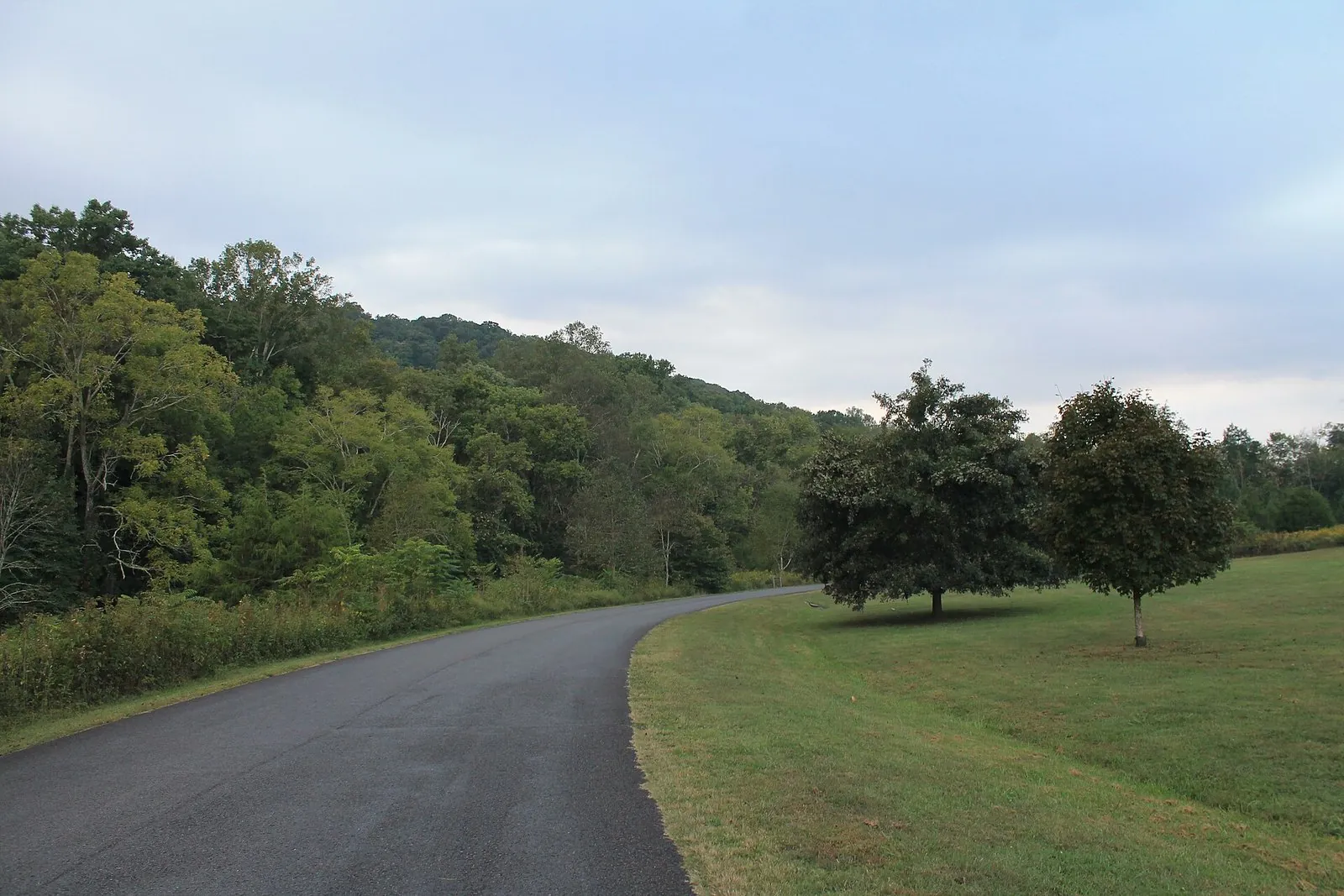
The best outdoor things to do in Nashville start closer to Broadway than most visitors expect: the 1.35-mile Lake Trail at Radnor Lake, about 20 minutes south; more than 3,100 acres of trails in the Warner Parks; the paved Shelby Bottoms Greenway along the Cumberland River; and a beginner-friendly paddle on the Harpeth River, about 40 minutes west.
This guide is for visitors who want a morning outside between nights on Broadway, and for anyone planning a longer stay. It covers the parks, lakes, greenways and rivers within about an hour of downtown, with trail lengths, dog and bike rules, hours and costs. The parks themselves are free; you pay only for boats, bikes and gas. The caveat that matters is distance. Davidson County covers more than 500 square miles, and apart from the riverfront, nothing on this list is a walk from a downtown hotel, so plan on a car or a rideshare.
Last updated October 10, 2026. Prices, rules and details checked October 2026.
The Short Version
Match the outing to the mood you’re in, then read the details further down.
| If you want… | Go to | Know this first |
|---|---|---|
| An easy, beautiful walk close to town | Radnor Lake State Natural Area | The Lake Trail is 1.35 miles; no dogs, jogging or bikes on the trails |
| A real hike without leaving the county | Percy Warner Park’s Mossy Ridge Trail | A 4.5-mile loop, rated moderate, blazed red |
| A long, quiet day in the woods | Beaman Park’s Laurel Woods Trail | 12.5 miles, about six hours |
| A bike ride or a flat run | Shelby Bottoms Greenway | More than 5 miles of paved trail along the Cumberland |
| Time on the water | The Harpeth River, or a pontoon on Percy Priest or Old Hickory Lake | Class I paddling for beginners; full-day pontoons from about $350 |
| A walk with the dog | Shelby Park, Centennial Park, Radnor’s Otter Creek Road | Radnor allows leashed dogs on Otter Creek Road only |
| Fresh air without a car | The riverfront and the John Seigenthaler Pedestrian Bridge | Free, downtown, best at sunset |
| A scenic drive | The Natchez Trace Parkway | The northern end is about 30 minutes southwest of downtown |
| A waterfall | Cummins Falls or Fall Creek Falls | Full day trips; Cummins needs a $7 gorge permit |
How do Nashville’s big parks and natural areas compare?
These are the places where most outdoor time in Nashville actually happens. Drive times are typical from downtown outside rush hour; add 15 minutes or more on weekday afternoons, when the interstates clog.
| Park | From downtown | What you get | Best for |
|---|---|---|---|
| Radnor Lake State Natural Area | About 20 minutes south | 1,368 acres, 7.75 miles of trail, a protected lake | Wildlife and an easy lakeside walk |
| Percy and Edwin Warner Parks | About 20 minutes southwest | 3,100+ acres; 12 miles of hiking trail, about 9 paved, 10 for horses | Proper hikes, road cycling, picnics |
| Shelby Bottoms Greenway and Natural Area | About 10 minutes east | 950-acre floodplain preserve; 5+ miles paved, 5+ primitive | Biking, running, strollers, birding |
| Beaman Park | About 30 minutes northwest | Three trails totaling 14.6 miles in steep Highland Rim forest | Long, quiet hikes |
| Long Hunter State Park | About 30 minutes east | A 2.1-mile paved loop around Couchville Lake, Percy Priest shoreline | An easy loop and lake views |
| Harpeth River State Park | About 40 minutes west | A class I river, the Narrows trails (0.8 mile in all) | Paddling and a short history walk |
| Centennial Park | About 10 minutes west | 132 acres, the Parthenon, a lake and a dog park | A city picnic with culture attached |
| Riverfront and pedestrian bridge | Walkable from downtown | Skyline views, Wasioto Park, Fort Nashborough | Fresh air without a car |
Two patterns are worth knowing before you choose. The wild places (Radnor, Beaman, the Warner Parks’ backcountry) sit on the hilly rim of the Nashville Basin, so they have the shade, the climbs and the wildlife. The river parks (Shelby Bottoms, the riverfront) are flat and open, which makes them better for wheels and worse in a July afternoon.
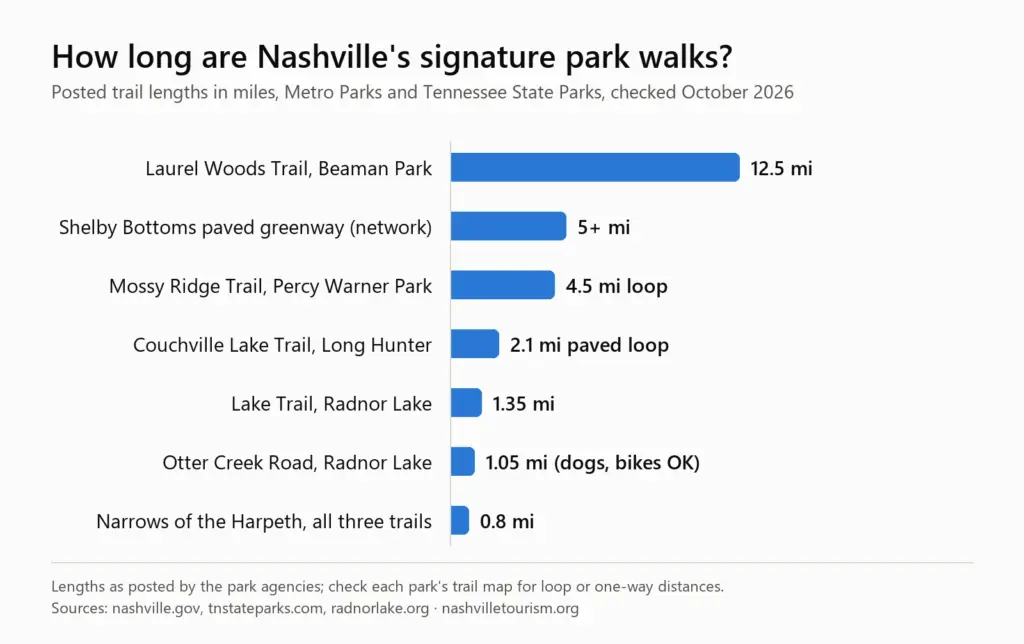
Use the chart as a time budget. At an easy wildlife-watching pace, Radnor’s Lake Trail and back takes about an hour; the Couchville Lake loop takes 45 minutes to an hour; Mossy Ridge takes two to two and a half hours with its climbs; and Laurel Woods is a six-hour commitment that needs an early start, lunch in your pack and a plan to be out before dark.
The best outdoor things to do in Nashville, ranked
The ranking favors what a visitor can do well in half a day, what’s distinctive to Nashville, and what repays the drive. Everything here is free unless a price is given.
1. Walk the Lake Trail at Radnor Lake
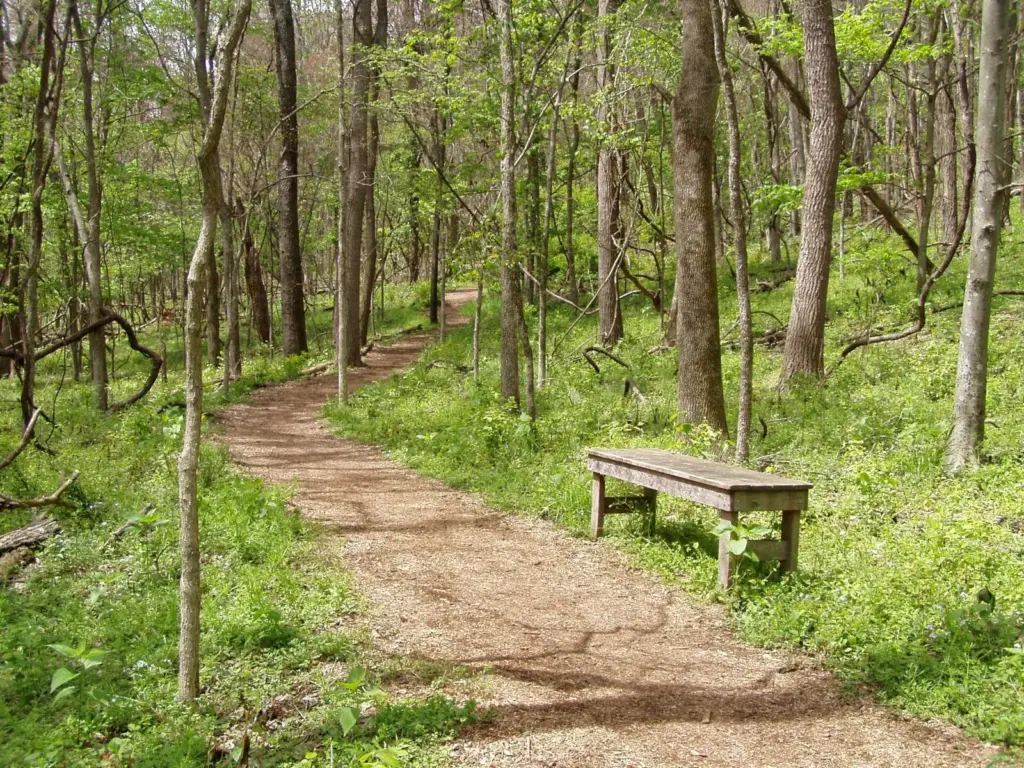
Radnor Lake is the outdoor place Nashvillians recommend first, and they’re right. It’s a 1,368-acre state natural area about 20 minutes south of downtown, built around a lake the L&N Railroad dammed in 1914 to water its steam engines, and it feels much farther from the city than it is. Deer browse beside the trail, herons work the shallows, turtles stack up on fallen logs, and in winter the open water fills with ducks.
The trail system totals 7.75 miles. The Lake Trail, 1.35 miles along the shore, is the one to walk if you only walk one; it’s mostly level and passes the best wildlife-watching spots. The Dam Walkway (0.20 mile) is ADA accessible, and the ridge trails climb into the hills on either side if you want a workout. Otter Creek Road, 1.05 miles and closed to cars inside the park, runs along the other side of the lake, and together with the Lake Trail it makes the loop most visitors walk.
Radnor’s rules are stricter than a city park’s. The trails are for hiking and wildlife watching only: no running, no jogging, no bikes and no pets. Leashed dogs, joggers and cyclists are welcome on Otter Creek Road and nowhere else. The park opens at 6am and closes 20 minutes after sunset every day of the year, including holidays, and the visitor center opens Thursday to Monday from 9:30am to 6pm, closing for lunch from 1pm to 2pm.
Go early. The parking lots are small for a park this popular, and on fine weekend mornings they can fill; a weekday at 7am gives you the wildlife and the quiet together. Entry and parking are free, as they are at every Tennessee state park.
2. Hike the Warner Parks
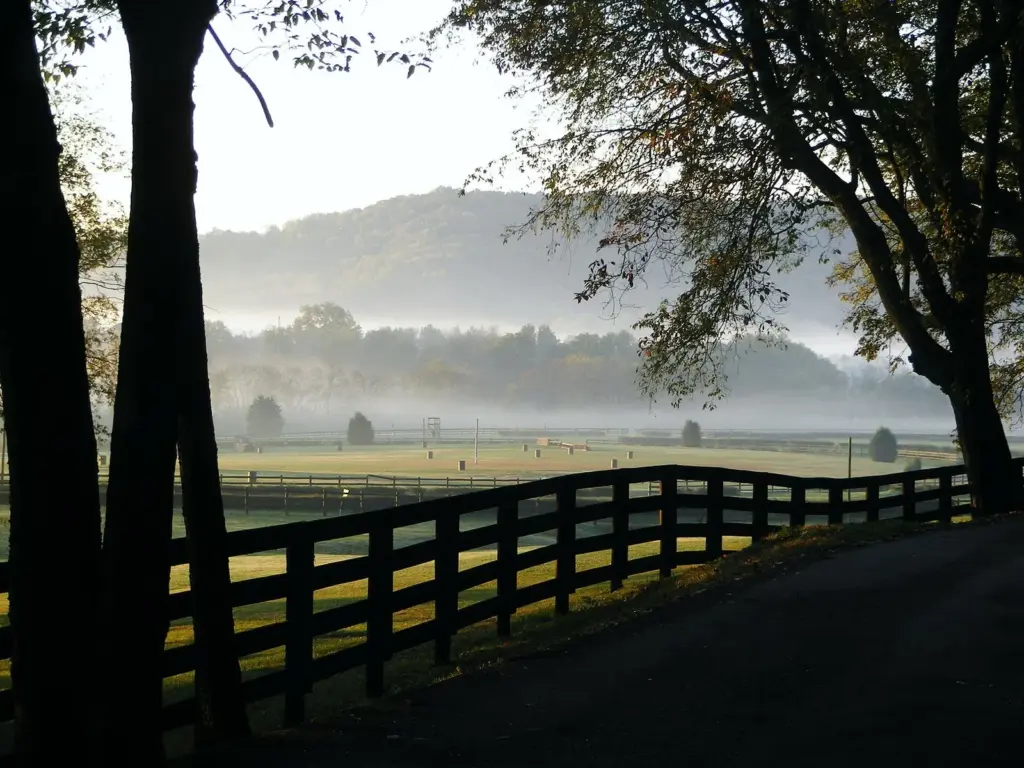
Percy and Edwin Warner Parks together cover more than 3,100 acres of ridges, hollows and meadows on the city’s southwest edge, about 20 minutes from downtown. This is where Nashville goes to hike properly. The parks have 12 miles of primitive hiking trail, about 9 miles of paved multi-use trail, 3 miles of paved trail connecting to the Harpeth River Greenway, 10 miles of horse trails and two cross-country running courses.
Start with the Mossy Ridge Trail, a 4.5-mile loop blazed in red and rated moderate. It climbs and drops through hardwood forest, crosses a few ridgelines and takes most walkers two hours or a little more. If that sounds like too much, the paved trails and quiet park roads make easy, shaded walks, and the meadows around the picnic areas are made for a blanket and a lazy afternoon.
Two details give the parks their character. The first is the stonework: gates, walls, bridges and steps built in the 1930s, much of it by Depression-era work crews. The second is the Allée at the Belle Meade Boulevard entrance, a long, straight drive that ends at a broad flight of stone steps, which has become the park’s favorite photo spot. The winding park roads are also the city’s favorite training ground for road cyclists, so drive them slowly.
The parks are open from sunrise to 11pm. The Warner Park Nature Center opens Tuesday to Saturday from 9am to 4pm and runs programs and guided hikes; register through Metro Parks. In spring, Percy Warner Park hosts the Iroquois Steeplechase, a race day that’s as much a garden party as a horse race; the 2027 running is Saturday, May 8.
3. Bike or walk the Shelby Bottoms Greenway
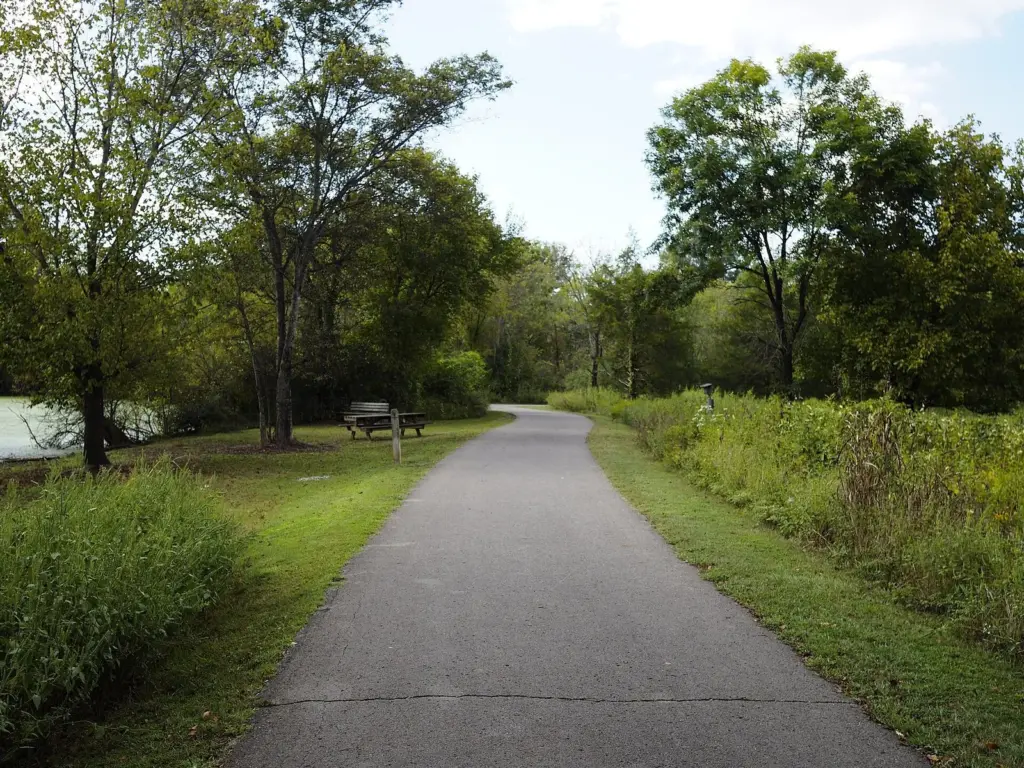
Shelby Bottoms is the flat, open counterpoint to Radnor’s woods: a 950-acre floodplain preserve along the Cumberland River in East Nashville, about 10 minutes from downtown. More than 5 miles of paved, ADA-accessible greenway run through meadows, wetlands and riverbank woods, with more than 5 miles of primitive trail looping off them. It’s the best place in the city for an easy bike ride, a flat run or a stroller walk, and one of the best for birds, since the mix of water, grass and woods draws everything from hawks to herons.
The Shelby Bottoms Nature Center, at 1900 Davidson Street, sits at the main trailhead with exhibits, restrooms and staff who know what’s been spotted lately. The greenway starts in Shelby Park, which adds a small lake, sports fields and an off-leash dog park. If you don’t travel with a bike, the greenway is just as good on foot; BCycle e-bikes rent through the app downtown, but the ride out uses city streets, so it’s simpler to drive or take a rideshare to the nature center.
Shade is thin on the open stretches. From June to August, go before 9am or after 6pm, and carry water whichever way you’re moving. For brunch or coffee afterward, East Nashville’s Five Points is a few minutes away.
4. Paddle the Harpeth River
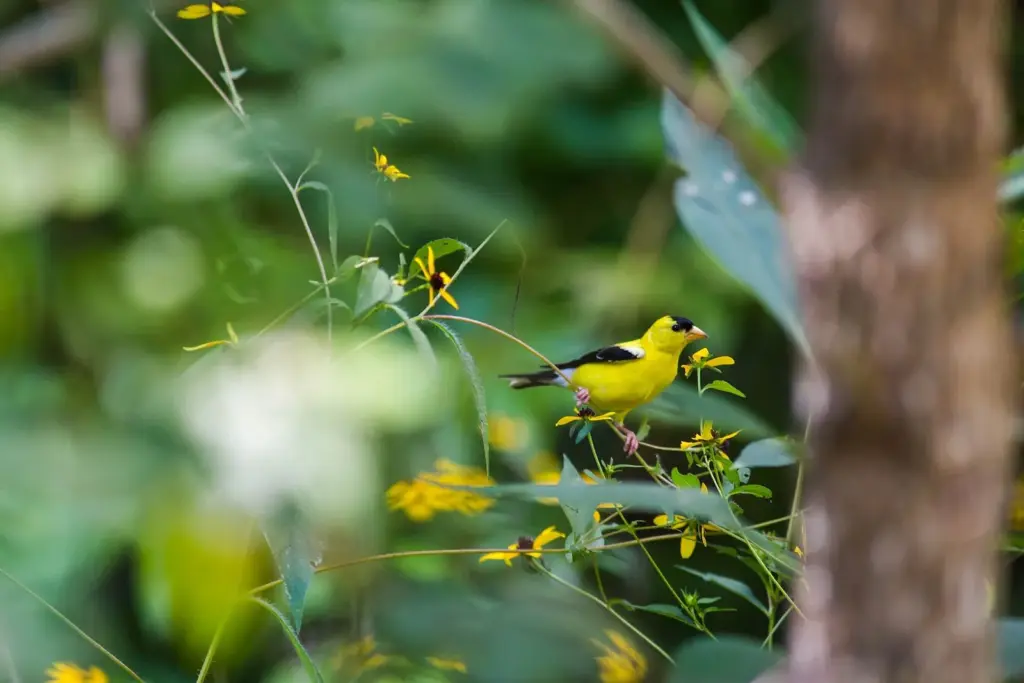
For time on the water with no experience, the Harpeth River is the answer. The stretch through Harpeth River State Park near Kingston Springs, about 40 minutes west of downtown, is a class I river: a gentle current, gravel bars, limestone bluffs and the occasional heron lifting off ahead of your boat. The state park rates it suitable for beginners, and local outfitters handle the boats, the shuttles and the advice.
Three outfitters work the river. Canoe Music City runs 2, 5 and 7-mile trips; Tip-A-Canoe, the oldest family-owned canoe rental in Tennessee, runs 5, 8 and 10-mile trips; and Foggy Bottom Canoe rents canoes and kayaks with advice for paddlers of all ages. Check current prices and seasons on their sites, and ask how the water looks that week. After heavy rain the Harpeth runs high, fast and muddy; by late summer some riffles get shallow enough that you’ll step out and drag the boat.
Leave time for the Narrows of the Harpeth, the park unit where three short trails totaling 0.8 mile start from one trailhead. The quarter-mile Tunnel Trail leads to the site of Montgomery Bell’s Pattison Forge and the tunnel his workers cut through a limestone ridge in the early 1800s to power it, often described as one of the earliest full-scale tunnels in the United States. The river loops almost all the way around that ridge, which is why put-ins and take-outs here sit so close together.
Harpeth River State Park keeps seasonal hours: 7am to 7pm in summer, 8am to 6pm in October and March, and 8am to 4:30pm in winter. Pack a dry bag, wear shoes that can get wet, and leave anything you’d hate to lose in the car.
5. Loop Couchville Lake at Long Hunter State Park
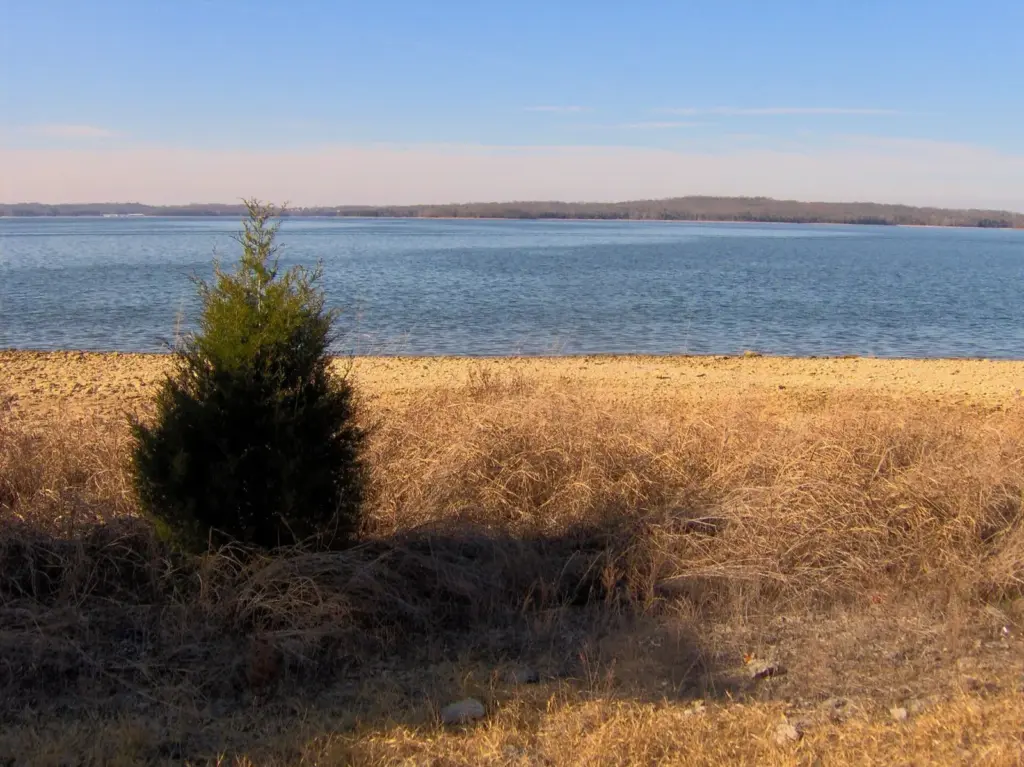
Long Hunter State Park sits on Percy Priest Lake at 2910 Hobson Pike in Hermitage, about 30 minutes from downtown. Its signature walk is the Couchville Lake Trail, a flat, paved and mostly shaded 2.1-mile loop around 110-acre Couchville Lake. That combination makes it one of the most accessible lake walks in the state park system, good for strollers, wheelchairs, older walkers and anyone nursing a Broadway hangover.
Beyond the loop, dirt trails follow the Percy Priest shoreline through cedar glades and hardwoods, including the Volunteer Trail, a longer route with backcountry campsites. Percy Priest itself is an Army Corps of Engineers reservoir on the Stones River, and Long Hunter is one of the easiest ways to see it without a boat. Winter gives the longest views across the water; spring brings wildflowers to the glades.
Like every Tennessee state park, Long Hunter is free to enter. Its programs, including guided hikes around Couchville Lake, are booked through the state parks’ reservation site.
6. Walk the riverfront and the pedestrian bridge
The one outdoor outing you can do on foot from a downtown hotel is also one of the best. The John Seigenthaler Pedestrian Bridge, a 1909 steel truss bridge that now carries only people and bikes, crosses the Cumberland River from SoBro to the East Bank, and the view of the skyline from its middle is the best free view in the city. Go at sunset, when the towers light up and the river turns orange.
At the east end, Wasioto Park, the riverfront park long known as Cumberland Park and renamed with the Shawnee name for the Cumberland River, has interactive water features and an amphitheater that children love on a hot afternoon. Back on the downtown side, Riverfront Park and the free Fort Nashborough Interpretive Center tell the story of the city’s 1779 founding and honor the region’s Native American nations.
The loop takes about an hour, costs nothing and needs no planning, which is why our list of free things to do in Nashville puts it near the top. If you’d rather cover more ground, BCycle e-bikes rent through the BCycle app, and our guide to getting around Nashville explains scooters, buses and rideshares.
7. Take a pontoon out on Percy Priest or Old Hickory Lake
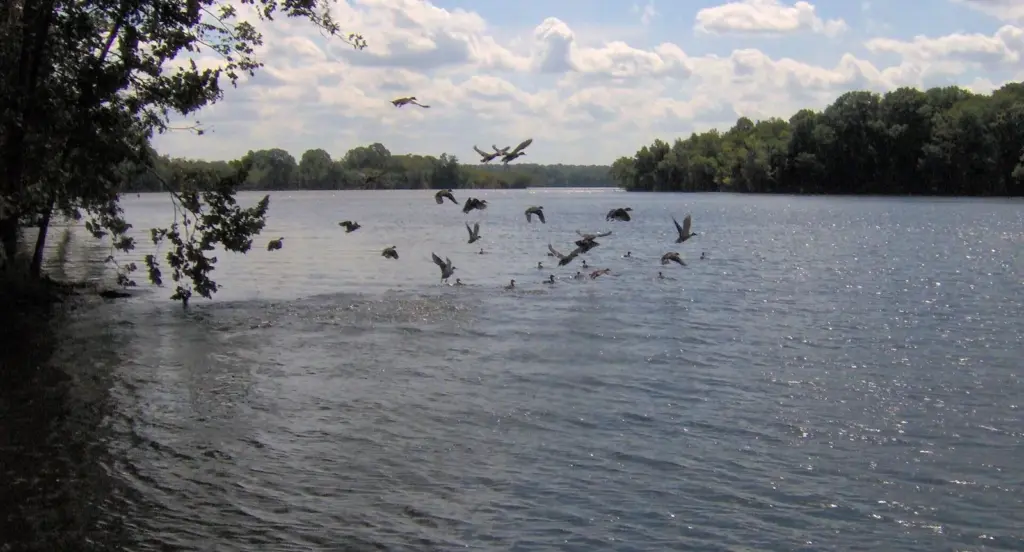
Nashville sits between two big Army Corps reservoirs: Percy Priest Lake to the east, near the airport, and Old Hickory Lake to the northeast, along the Cumberland toward Hendersonville and Gallatin. A rented pontoon is the classic local way to spend a summer day on either: a slow cruise, a swim off the back in a quiet cove and a cooler on board.
Sample 2026 prices show the range. Sun Life Elm Hill Marina on Percy Priest rents self-drive pontoons for a full day (9am to 5pm) from $425 for a 25-footer to $675 for a deluxe 30-footer, for 8 to 20 guests, with fuel extra and a $300 card hold, and it advises booking one to two weeks ahead in peak season. On Old Hickory Lake, Sweetwater Pontoon Rentals charges $350 on weekdays, $500 on Sundays and $600 on Saturdays for a 22-foot pontoon, and $550 to $675 for a 26-foot double-decker. Saturday costs $250 more than a weekday for the same boat, so a Tuesday on the lake is one of the better money moves in this guide.
Before you book, ask the marina about Tennessee’s boater-education rule, which applies to motorboat operators born after January 1, 1989, and about who can drive. Split ten ways, a $350 weekday pontoon comes to $35 a person before fuel. If you’re planning a celebration rather than a swim, our Nashville bachelorette party guide compares the party boats on the Cumberland too.
8. Hike Beaman Park
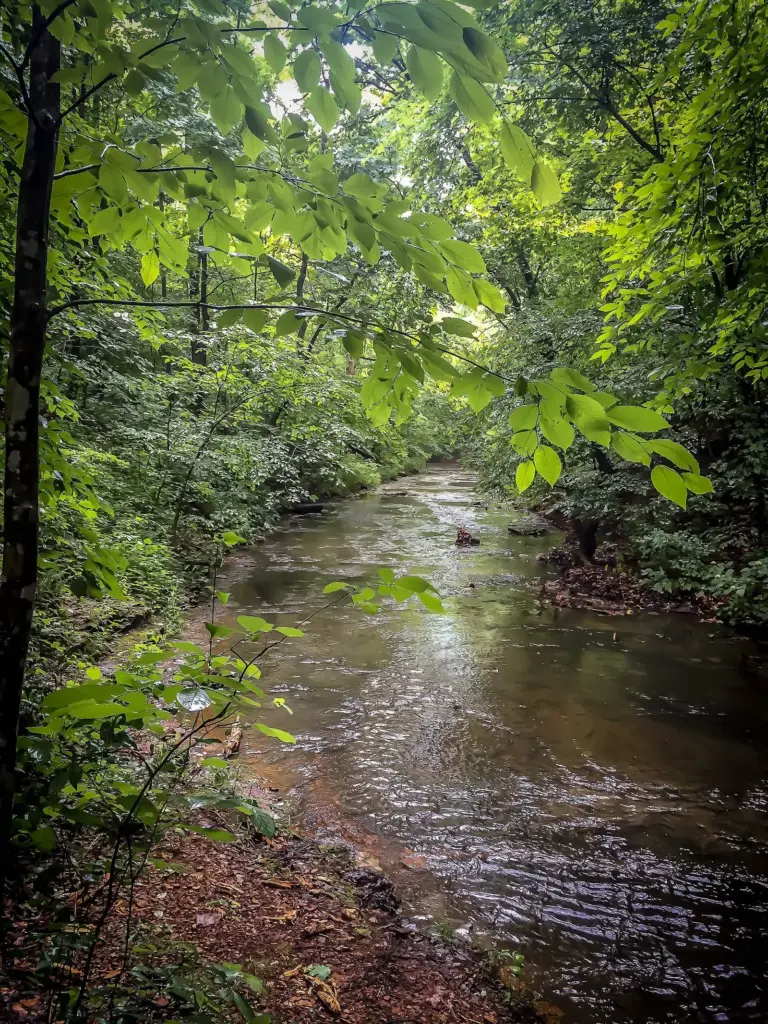
Beaman Park is the city’s wild card: a big, steep, quiet forest on the Highland Rim northwest of downtown, with its nature center at 5911 Old Hickory Boulevard, about 30 minutes away. It sees a fraction of Radnor’s crowds, and on a weekday you can walk for an hour without meeting anyone.
Three hiking trails total 14.6 miles. The Laurel Woods Trail accounts for 12.5 of them, running from the Highland Trailhead through the hollows and over the ridges for about six hours of hiking. The other two add 2.1 miles between them, enough for an hour’s walk down to the creeks and back. Bring water, a map and decent shoes; the hills here are steeper than anything at Radnor, and the long trail is no place to run out of daylight.
9. Drive or bike the Natchez Trace Parkway
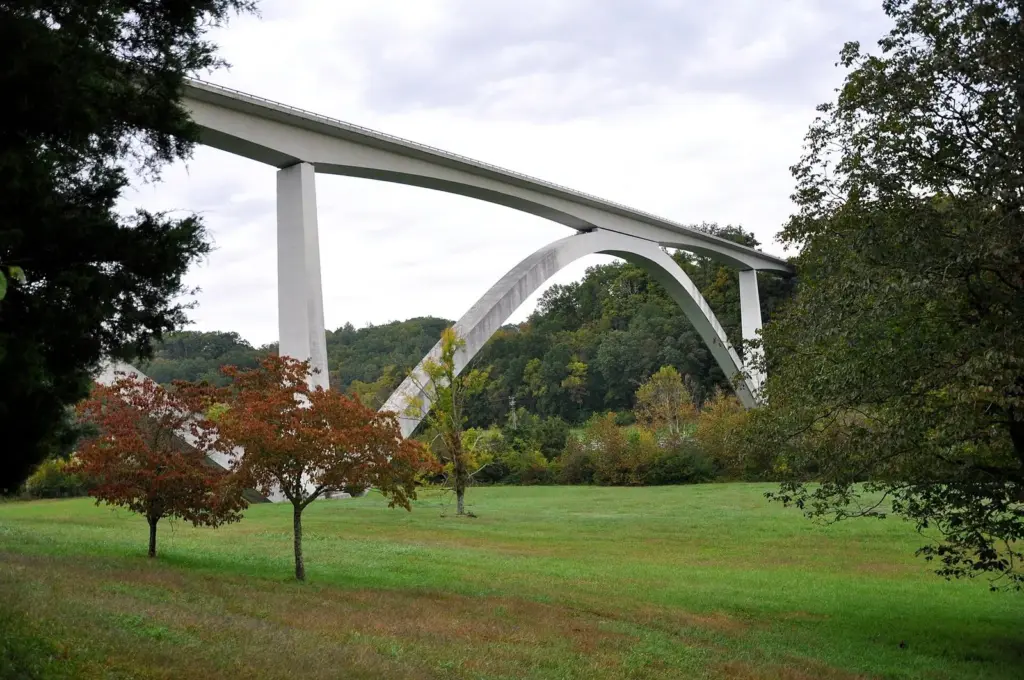
The Natchez Trace Parkway is a 444-mile National Park Service road that follows an old travel route between the Nashville area and Natchez, Mississippi. Its northern end begins at Highway 100, about 30 minutes southwest of downtown. There are no billboards, no commercial trucks and a 50 mph speed limit, so even a short stretch makes a calm drive through farmland and woods.
The obvious target is the Double Arch Bridge, which carries the parkway high above Highway 96 near Franklin, about 40 minutes from downtown; there’s a pull-off for photos. Cyclists ride the parkway too, so give them a full lane when you pass. Fall color, usually late October into early November, is the prime time, and a loop that returns through Franklin turns the drive into a half day.
10. Spend an afternoon in Centennial Park
Centennial Park, next to Vanderbilt about 10 minutes west of downtown, is Nashville’s classic city park: 132 acres with walking paths, Lake Watauga, a dog park and the full-scale replica of the Parthenon, whose art museum charges adults $15. From spring into September, Musicians Corner puts on free concerts on the lawn; the 2026 season ran from May 15 to September 25. It’s the easiest green space to combine with a museum, a meal in Midtown or a walk across the Vanderbilt campus, and our guide to Nashville attractions has the Parthenon’s hours and the rest of the paid sights nearby.
11. Walk the gardens at Cheekwood
Cheekwood Estate & Gardens is the paid option on this list and the best one for gardens: a 1930s mansion and art museum set in landscaped grounds, about 20 minutes southwest of downtown near the Warner Parks. Adult tickets run $26 to $32 and youth tickets $20 to $26 depending on the date, plus a per-ticket service fee and $5 parking. Spring, when the bulbs bloom, and the Holiday LIGHTS evenings in winter are the peak seasons, and both are worth booking ahead.
12. Picnic to free music at Arrington Vineyards
Arrington Vineyards, 25 miles (about 35 minutes) south of downtown, is the most relaxed outdoor afternoon near Nashville: free admission, rolling hills of vines and free live music in season, on Saturdays from 3pm to 7pm and Sundays from 2pm to 6pm. You can carry in your own picnic, though not outside alcohol, delivered picnics or charcuterie set-ups. A self-guided tasting flight costs $16. Pick a designated driver before you go; the drive back is on rural two-lane roads.
13. Chase a waterfall: Cummins Falls and Fall Creek Falls
Nashville has no big waterfalls of its own, but the Cumberland Plateau to the east has plenty, and two make strong day trips. Cummins Falls State Park, about an hour and a half east near Cookeville, has a 75-foot falls with a swimming hole at its base. Reaching the gorge needs a $7 gorge access permit, capped at 200 a day and sold online until 4pm or until they run out, and the gorge closes in bad weather. In season the park opens 8am to 6pm, with the gorge closing at 5pm.
Fall Creek Falls State Park, roughly two hours southeast, has one of the tallest waterfalls in the eastern United States at 256 feet, with overlooks a short walk from the parking areas. Both make long days, so start early. Our guide to day trips from Nashville covers the drives, the pairings and what else is on the way.
14. Walk Bicentennial Capitol Mall State Park
Bicentennial Capitol Mall is the state park you can reach from downtown on foot: a long, formal green that runs north from the foot of the State Capitol, opened in 1996 for Tennessee’s 200th birthday. It’s more history lesson than nature walk. The 200-foot granite map of Tennessee is set into the ground so you can walk across the state, the fountains are a summer favorite with children, and a long wall traces Tennessee history in stone, with a carillon of 95 bells, one for each county.
It’s free, flat and open, so go early or late in summer. Pair it with the Nashville Farmers’ Market beside it for lunch, the free Tennessee State Museum next door and a climb up Capitol Hill for the view back down the mall. From Lower Broadway it’s a walk of 20 to 25 minutes.
When is the best time for outdoor things to do in Nashville?
Middle Tennessee has four real seasons, and each changes what’s worth doing. These are the 1991 to 2020 averages for the airport, which is a fair guide to the parks.
Spring (March to May): highs climb from 63°F in March to 73°F in April and 80°F in May. Wildflowers carpet the Warner Parks and Radnor hollows in April, the rivers run full, and the trails can be muddy after storms. It’s the best season for the Harpeth if the water isn’t too high, and for Cheekwood’s gardens.
Summer (June to August): highs of 88°F to 91°F with heavy humidity. Hike at dawn, paddle and boat in the afternoon, and stay off exposed trails between noon and 5pm. Ticks and chiggers are part of the deal in the woods; use repellent and check yourself after every hike. Weekend lake days get busy, so book boats early.
Fall (September to November): September still averages 84°F, but October drops to a comfortable 74°F and November to 61°F. This is the best hiking season, and fall color usually peaks from late October into early November. If you can choose one month for an outdoors trip, choose October.
Winter (December to February): highs around 49°F to 54°F, and about 4.7 inches of snow in an average year, usually spread over a few days. Bare trees open up the views, Radnor’s lake fills with waterfowl, and the parks are close to empty. Paddling and pontoons are off the table, but hiking is good most days. For the month-by-month picture of crowds and prices too, see our guide to the best time to visit Nashville.
Dogs, bikes, parking and other rules worth knowing
- Dogs: Radnor Lake allows leashed dogs only on Otter Creek Road, never on its trails or in the lake. Shelby Park has an off-leash dog park at the start of the greenway, and Centennial Park has a dog park in Midtown. Elsewhere, keep dogs leashed and read the trailhead signs.
- Bikes: no bikes on Radnor’s trails (Otter Creek Road is fine). The Shelby Bottoms Greenway and the Warner Parks’ paved trails are the best rides. Downtown, BCycle e-bikes rent through the app, and e-scooters are banned from sidewalks in the downtown core.
- Running: Radnor’s trails are walking-only, so run on Otter Creek Road, the Shelby Bottoms Greenway or the Warner Parks’ paved paths and cross-country courses.
- Fees and parking: Metro parks and Tennessee state parks are free to enter, and trailhead parking at the parks in this guide is free. The paid exceptions are Cheekwood, boat and canoe rentals, and the $7 Cummins Falls gorge permit.
- Hours: Radnor opens at 6am and closes 20 minutes after sunset; the Warner Parks are open sunrise to 11pm; Harpeth River State Park keeps seasonal hours. Plan to be back at the car before closing.
- Heat: July averages a 91°F high. Start summer hikes by 8am and carry more water than you think you need.
- Water safety: rivers rise fast after storms. If it has rained hard upstream, skip the Harpeth for a day, and never enter a closed gorge at Cummins Falls.
Metro Parks runs about 190 parks and more than 100 miles of greenways across the county, so if you’re staying in a neighborhood rather than downtown, there’s probably a greenway within a short drive. The parks above are the ones worth crossing town for.
What to pack for a Nashville hike or paddle
Nothing here needs technical gear, but a few things separate a good morning from a miserable one.
- Water, and more than you think: a liter for a short walk in spring or fall, two or more for any summer hike or float.
- Insect repellent: ticks and chiggers live in the long grass and leaf litter from spring to fall. Use repellent, stay on the trail and check yourself afterward.
- Shoes with grip: limestone gets slick when wet, and the Warner Parks and Beaman trails climb steeply. For paddling, shoes that can get soaked.
- A downloaded trail map: Metro Parks and Tennessee State Parks post maps online. Save one to your phone before you leave town.
- Layers in spring and fall: mornings in the 40s can turn into afternoons in the 70s in April and October.
- A dry bag for the river: phones, keys and car fobs do not survive a capsized canoe.
Camping near Nashville
If a night under the stars is part of the plan, you don’t have to go far. The campgrounds fall into three groups, and each books through a different system.
Army Corps lake campgrounds. The Corps of Engineers runs campgrounds on both Percy Priest and Old Hickory lakes, with Seven Points on Percy Priest, near Hermitage, among the best known. They book through Recreation.gov, sites near the water go first on summer weekends, and they put you a short drive from a boat ramp.
State park campgrounds. Several Tennessee state parks within about an hour of downtown have campgrounds, including Montgomery Bell to the west near Burns, Cedars of Lebanon to the east near Lebanon and Bledsoe Creek on Old Hickory Lake near Gallatin. Long Hunter’s Volunteer Trail adds backcountry sites for backpackers. All book through the state parks’ reservation website, and entry to the parks themselves stays free.
Private RV parks. The Nashville KOA Resort in the Music Valley area near Opryland is the obvious choice if you want hookups and a short ride to the Opry, and other private RV parks cluster along the interstates.
Whichever you choose, book early for spring and fall weekends, the busiest camping seasons, and check burn bans before you plan a campfire in a dry late summer.
Outdoor concerts and events
Some of Nashville’s best outdoor hours come with a soundtrack. From spring into September, Musicians Corner puts on free concerts in Centennial Park, with food trucks and families on blankets; its 2026 fall series ran Friday evenings and Saturday afternoons through September 25. Live On The Green, presented by the radio station Lightning 100, is a free concert series at Public Square Park downtown; check its site for the year’s dates, which weren’t posted when we checked.
For paid shows, Ascend Amphitheater on the riverfront holds about 6,800 people, roughly 2,300 in fixed seats and 4,500 on the lawn, and the lawn on a warm night is one of the better concert experiences in town. Out in the country, Arrington Vineyards’ free weekend music runs from spring into the fall. In May, the Iroquois Steeplechase brings hats, tailgates and horse racing to Percy Warner Park, and the free Fourth of July concert and fireworks on the riverfront draw one of the biggest crowds of the year. Our guide to live music in Nashville covers the indoor stages for the rest of the evening.
Easy outdoor half-days for visitors
The early bird: Radnor Lake at 7am for the Lake Trail and the wildlife, then breakfast in 12South or Berry Hill on the drive back, and you’re downtown by 10:30 with the day still ahead. Our guide to Nashville neighborhoods covers where to eat in both.
The water day: a morning float on the Harpeth with an outfitter near Kingston Springs and a look at the Narrows tunnel, then, if you have energy left, the Natchez Trace Parkway back toward town by way of the Double Arch Bridge.
The family morning: the paved Couchville Lake loop or the Shelby Bottoms Greenway with a stroller, a stop at a nature center, then lunch and the splash features at Wasioto Park. Our guide to things to do in Nashville with kids has more ideas for little legs.
The no-car evening: the pedestrian bridge at sunset, Wasioto Park and the riverfront, then dinner and music downtown. Our Nashville itinerary shows where an outdoor half-day fits around the music and the food, and our list of things to do in Nashville covers the indoor backups for a rainy day.
Where to stay if the outdoors is the point
Downtown hotels put you next to the riverfront and Bicentennial Mall, but every big park is a drive away. If outdoor time is the heart of your trip, base yourself where the parks are. Midtown, West End and Belle Meade sit 10 to 20 minutes from Centennial Park, the Warner Parks, Cheekwood and Radnor Lake. East Nashville is a few minutes from Shelby Bottoms and an easy run to Old Hickory Lake. Hermitage and Donelson, near the airport, are closest to Percy Priest Lake and Long Hunter State Park, though you trade nightlife for convenience. Our guide to where to stay in Nashville compares the areas, prices and what each is like at night.
Nashville Outdoors FAQ
What are the best outdoor things to do in Nashville?
For a first visit, walk Radnor Lake’s 1.35-mile Lake Trail early in the morning, hike Percy Warner Park’s 4.5-mile Mossy Ridge loop, ride or walk the paved Shelby Bottoms Greenway, and paddle the Harpeth River with an outfitter near Kingston Springs. Without a car, cross the John Seigenthaler Pedestrian Bridge downtown at sunset. The parks are all free.
Can you bring a dog to Radnor Lake?
Only on Otter Creek Road. Radnor Lake State Natural Area bans pets from its trail system and the lake, but leashed dogs are allowed on Otter Creek Road, a 1.05-mile stretch closed to cars inside the park. For off-leash time, Shelby Park’s dog park at the start of the Shelby Bottoms Greenway or Centennial Park’s dog park are better choices.
Do the state parks near Nashville charge admission?
No. Tennessee’s state parks, including Radnor Lake, Long Hunter and Harpeth River, are free to enter, and hiking is always free. Some activities need a permit or a reservation, though: the gorge at Cummins Falls requires a $7 gorge access permit, capped at 200 a day, and campsites and guided programs are booked through the state parks’ reservation website.
Where can you kayak or canoe near Nashville?
The Harpeth River near Kingston Springs, about 40 minutes west of downtown, is the best beginner paddle: a class I river where outfitters such as Canoe Music City, Tip-A-Canoe and Foggy Bottom Canoe run trips of 2 to 10 miles with shuttles. Check the water level before you go, because the river runs high and fast after heavy rain.
Can you enjoy the outdoors in Nashville without a car?
Yes, downtown. Walk the John Seigenthaler Pedestrian Bridge over the Cumberland River for skyline views, then explore Wasioto Park on the East Bank and Riverfront Park with the free Fort Nashborough Interpretive Center. BCycle e-bikes rent through an app. The big parks, though, are 10 to 40 minutes away by car or rideshare, so budget for the ride.
When is the best time of year to hike in Nashville?
October is the sweet spot, with average highs around 74°F and fall color that usually peaks from late October into early November. April and May come close, with wildflowers and highs in the 70s. Summer works if you start by 8am, since July averages a 91°F high, and winter is mild enough for hiking on most days.
How far is the nearest big waterfall from Nashville?
Cummins Falls State Park, near Cookeville, is about an hour and a half east and has a 75-foot waterfall with a swimming hole; reaching the gorge needs a $7 permit. Fall Creek Falls, roughly two hours southeast, has a 256-foot falls with overlooks a short walk from the parking areas. Each one makes a full-day trip.
Related Nashville Guides
- Day Trips from Nashville: waterfalls, state parks and small towns within a few hours
- Free Things to Do in Nashville: parks, music and museums that cost nothing
- Best Time to Visit Nashville: weather, crowds and prices month by month
- Things to Do in Nashville with Kids: family picks indoors and out
- Nashville Itinerary: how to fit an outdoor morning into a short trip
Sources and verification
Trail lengths, rules, hours and prices in this guide were checked on October 3, 2026 against the park agencies and operators listed below; the guide is based on that research and does not claim first-hand visits.
- Tennessee State Parks: Radnor Lake State Natural Area
- Friends of Radnor Lake: park rules
- Metro Parks: Warner Parks maps and trails
- Metro Parks: Shelby Bottoms Greenway and Natural Area
- Metro Parks: Beaman Park hiking and trails
- Metro Parks: greenways and open space
- Tennessee State Parks: Long Hunter hiking
- Tennessee State Parks: Harpeth River paddling
- Tennessee State Parks: frequently asked questions
- Tennessee State Parks: Cummins Falls gorge permits
- Sun Life Elm Hill Marina: pontoon rentals
- Sweetwater Pontoon Rentals
- Cheekwood Estate & Gardens: tickets
- Arrington Vineyards
- Visit Music City: free things to do, including park figures
Photo credits
- Radnor Lake trail: photo by Jonathan James from Nashville, USA, Wikimedia Commons (CC BY 2.0)
- Percy Warner Park in October: photo by MICHAEL BROWN from Franklin, Tennessee, USA, Wikimedia Commons (CC BY 2.0)
- Shelby Bottoms Greenway: photo by MaxKelley620, Wikimedia Commons (CC BY 4.0)
- American goldfinch, Harpeth River State Park: photo by Melissa McMasters from Memphis, TN, United States, Wikimedia Commons (CC BY 2.0)
- Percy Priest Lake from Long Hunter State Park: photo by Brian Stansberry, Wikimedia Commons (CC BY 3.0)
- Old Hickory Lake at Bledsoe Creek: photo by Brian Stansberry, Wikimedia Commons (CC BY 3.0)
- Beaman Park creek: photo by Christina Blust, Wikimedia Commons (CC BY-SA 2.0)
- Double Arch Bridge, Natchez Trace Parkway: photo by NPS Photo, Wikimedia Commons (public domain)
- Edwin Warner Park (featured image): photo by Peg Duthie, Wikimedia Commons (CC BY-SA 4.0)
Photos are from Wikimedia Commons and have been resized for the web. The chart is our own, drawn from the figures in this guide.